10 Essential Payroll Software Features for UK Businesses
If you are still running payroll manually in 2026, you are far away from modern payroll processes. For small and medium-sized businesses, features of payroll software can be extremely useful. It helps you to reduce administrative burden and ensure compliance with UK tax regulations and employment laws.
In this article, we have shared the essential payroll software features that every owner of a growing business should know before choosing any payroll platform.
What is payroll software?
Moern payroll software is a tool that helps businesses manage everything related to paying their employees, which includes calculating salaries, deducting taxes, processing payments, handling pension contributions, and generating payslips. It simply replaces spreadsheets and manual calculations. Today, many businesses also choose HR and payroll software together to manage employee records, payroll processing and HR tasks from a single platform. For broader view, take a look at our blog on what is payroll software?
Why choosing the right features of payroll software matters
Here are some of the key reasons why choosing payroll management software with the right features matters for your business.
Saves time by streamlining payroll tasks
Running payroll every month consumes a lot of time. When you are calculating salaries and other payroll processes manually, even if you are a small team, it can take hours. The right payroll system automates most of these tasks so your HR or finance team can focus on more important things.
Reduces errors and increases accuracy
Payroll mistakes are more common than you think. A wrong tax code or an incorrect salary can cause real problems for both the employee and the business. A good payroll system runs calculations automatically and flags errors before they become a headache.
Ensures compliance with changing regulations
If the tax rules, UK minimum wage or pension contribution rules are changed, the right software stays updated with the latest regulations and handles compliance in the background so you don’t have to. Because, as a small business owner, updating all of them manually is nothing but a nightmare.
Improves financial visibility and control
You can see where your money is going when your payroll data is organised in one place. Payroll reports give you a clear picture of your total labour costs and all other expenses. That kind of visibility helps you make better decisions, especially when you are planning headcount or managing budgets.
Supports business growth with flexible tools
A tool that works for 20 employees might not work for 200. Your payroll needs become more complex when your team grows. But the right payroll system scales with you instead of holding you back.
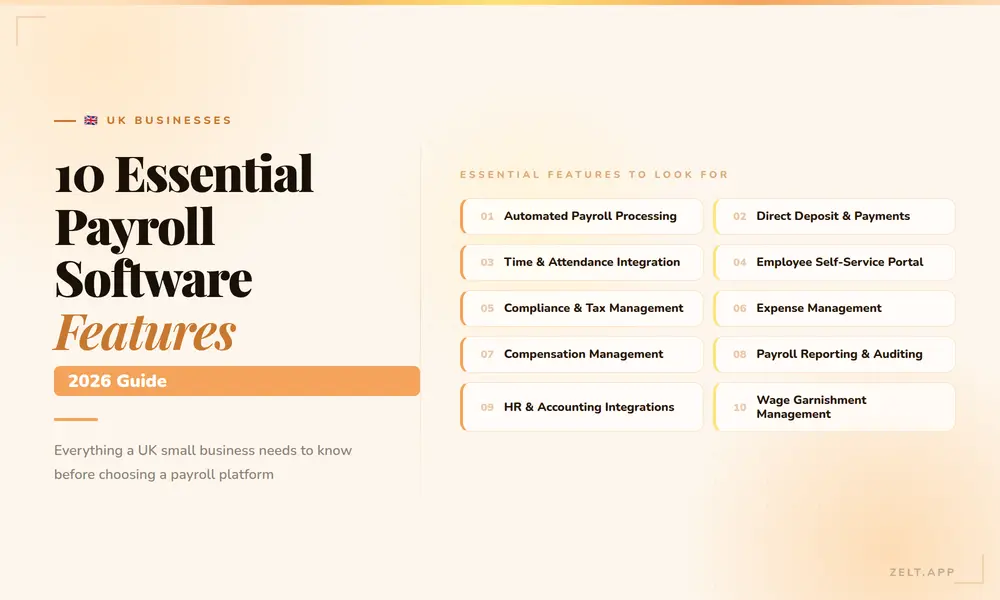
10 essential payroll software features
While every business has different payroll requirements, there are certain features that every modern payroll management software should include.
1. Automated payroll processing and tax calculations
This is the foundation of any good payroll system. Instead of manually calculating each employee’s gross pay, deductions and net salary, the software does it all automatically based on the data you have set up. It also calculates income tax, National Insurance contributions and pension deductions according to current HMRC rules.
2. Direct deposit and flexible payment methods
Employees expect to be paid directly into their bank accounts and good payroll software makes that happen without any manual steps. You process payroll, the system generates the payment files, and the money goes out.
But not every team is the same. Some businesses have employees on different pay schedules, some pay contractors differently and some need to support multiple currencies for international hires. Flexible payment options mean you can handle all of that without workarounds.
3. Time tracking and attendance integration
If your payroll system does not talk to your time tracking tool, someone on your team is manually transferring hours worked into a spreadsheet. That is a waste of time and an easy place for errors to creep in.
When time tracking integrates directly with payroll, hours are pulled through automatically. Overtime is calculated correctly. Shift allowances are applied without anyone having to check. It makes pay run day a lot less stressful.
4. Employee self-service portal
This one is something employees actually notice and appreciate. A self-service portal lets your team view their payslips, download P60s, update their bank details, and check their leave balances without emailing HR every time.
5. Compliance and tax management
In the UK, payroll compliance means staying on top of PAYE, National Insurance, auto-enrolment pensions, RTI submissions to HMRC and more. Miss something, and you are looking at fines or corrections that take time to sort out.
Good software keeps all of this in check automatically. It submits RTI reports to HMRC after every pay run, manages pension enrolment and contributions and updates tax codes when HMRC sends new ones (The standard tax code is 1257L Tax code for year 2026). You should not have to think about this stuff, the software should handle it in the background.
6. Expense management
Expense management is not always included in payroll software, but when it is, it makes life a lot easier. Employees can submit expenses directly through the system, managers can approve them, and the approved amounts are added to the next payroll automatically.
No more collecting receipts in a spreadsheet, no more manual calculations, and no more paying expenses separately from payroll. It all flows through one process.
7. Compensation management
Managing salaries across a growing team can get complicated quickly. Different roles, different pay grades, bonuses, commission structures, salary reviews, it adds up. Compensation management features let you track all of this in one place so you have a clear view of what everyone is earning and why.
8. Payroll reporting and auditing
Reports are how you stay in control of your payroll costs. A good payroll system lets you pull up breakdowns by department, employee type, pay period or cost centre. You can see exactly what was paid, when, and to whom.
9. Seamless HR and accounting integrations
Payroll does not live in a silo. It connects to your HR system for employee data, to your time tracking tool for hours worked, and to your accounting software for posting payroll costs to the right ledger.
When these integrations work properly, data flows between systems without anyone having to manually export and import files. It reduces errors and saves time across multiple teams, not just HR.
10. Wage garnishment management
Wage garnishments happen when an employee has a court-ordered deduction, like a child support payment or a debt repayment. It is not something that comes up every day, but when it does, you need to handle it correctly. Payroll software that supports wage garnishment management lets you set up these deductions properly, ensures the right amounts are withheld each pay cycle, and keeps a record in case it is ever questioned.
How to choose the right payroll software
Knowing the features is one thing. Choosing the right payroll platform that actually fits your business is another. Here is a simple process to follow.
- Define your must-have features first: Write down the three to five payroll problems that are consuming the most time of your team and build your feature list around solving those problems first.
- Check for compliance coverage in your region: If you are based in the UK, make sure the software handles PAYE, RTI submissions and auto-enrolment automatically. Ask the vendor directly how they handle HMRC updates and how quickly they roll out changes when regulations shift.
- Look for scalability as your team grows: Check whether the software can handle more employees and more complex pay structures. You do not want to be switching platforms every couple of years.
- Read user reviews and test with a free trial: Read what actual users are saying on G2, Capterra or Trustpilot, specifically from businesses of a similar size to yours. Then test it yourself before making any decision.
Don’t rush while choosing, take your time and see whether the platform can provide what your business needs or not. Read our guide on 10 best payroll software in the UK to choose the best one.
Get all the payroll features you need with Zelt
While choosing any software, make sure you get the one that is actually suitable for your business and takes the burden off. There are several tools available in the market but Zelt’s payroll software stands out the best payroll solution for small to medium size UK businesses.
Zelt brings payroll, HR and people management into one platform so you are not jumping between tools. From automated PAYE calculations to real-time reporting, Zelt gets all the payroll software features you need in one place. Book a demo today so you can see how Zelt works.