Free Payslip Template: Download Excel & PDF

If you are running a business and don’t have any financial management experience, every small opportunity to make pay run easier is something you should take.
In this article, I will share what payslips are and will provide a free payslip template so you can pay your people accurately on time. Along with everything you need to issue payslips confidently and correctly from day one.
And if you are looking for a more efficient way to streamline your payroll process, you can use our payroll software.
Free Payslip Template – Download Yours Now (Excel & PDF)
Before we get into the detail, here’s what you came for. Both templates are fully editable so you can easily create your payslips for the 2026/27 tax year and use them immediately, with no software subscription required.

Enter your details below to receive the template via email. Want to suggest improvements or spot something missing? We’d love to hear from you on info@zelt.app
Both templates include the key information required on a UK payslip, with clear labelling so you can fill them in accurately even if payroll isn’t your day job.
See how Zelt brings payroll, HR, and people management together in one connected platform.
What Is a Payslip?
A payslip, also called a pay statement or wage slip, is a written document that shows an employee exactly what they’ve been paid and what’s been deducted from their wages during a specific pay period. Simply, it’s the breakdown behind the number that lands in their bank account.
A payslip is a structured record for HMRC and can be provided either physically or digitally. If you don’t keep a record, you can run into legal issues. It also makes the pay run easier and saves your time.
Who Needs to Issue a Payslip?
Since April 2019, the law has been clear that all workers, not just employees, are entitled to a payslip. That includes:
- Full-time and part-time employees
- Workers on zero-hours contracts
- Agency workers (issued by the agency)
- Casual or irregular workers
The only people excluded are genuinely self-employed contractors and freelancers who invoice you directly (more on that below).
If someone is on your payroll — if you’re deducting PAYE and National Insurance on their behalf — they need a payslip. No exceptions, no matter how small your business or how informal the arrangement.
When Must Payslips Be Given to Employees?
Payslips must be provided on or before the date of payment. Issuing them late is a breach of employment law, even if the pay itself arrives on time. In practice, most employers issue payslips:
- The day before or the day of pay for bank transfers
- In advance for employees who collect physical payslips
If you miss a payslip, you can issue it retrospectively, but if an employee makes a tribunal claim, late or missing payslips are taken seriously. Employment tribunals can require you to produce records for the previous two years, so getting into a reliable system early matters.
What Must a UK Payslip Include? (HMRC Requirements 2026)
This is where many employers go wrong, especially those using a basic template they found years ago. Here’s what every UK payslip must include in 2026 to comply with HMRC:
Employee information:
- Employee’s full name
- Employee number (best practice, not always mandatory but strongly recommended for HMRC purposes)
- Tax code
- National Insurance (NI) category letter
Pay period information:
- Pay period dates (e.g., 1 April to 30 April 2025)
- Payment date
Pay details:
- Gross pay (total before deductions)
- Net pay (total after all deductions — the amount paid)
Deductions — clearly itemised:
- Income tax (PAYE)
- Employee National Insurance contributions
- Any other fixed deductions (e.g., pension, union fees, court orders)
- Any variable deductions, itemised separately
For variable-pay workers (since April 2019):
- Number of hours worked, where pay varies by hours
One thing you should not miss constantly is to itemise variable deductions separately. It’s not enough to show a single “deductions” total. Each deduction type must be listed on its own line.
What Is PAYE on a Payslip?
PAYE stands for Pay As You Earn, it’s HMRC’s system for collecting income tax directly from an employee’s wages before they receive them. On a payslip, PAYE appears as a deduction from gross pay. The amount deducted depends on the employee’s:
- Tax code (e.g., 1257L for the standard personal allowance in 2025/26)
- Gross earnings for the period
- Cumulative earnings year to date
The personal allowance for 2026/27 is £12,570, meaning most employees pay no tax on the first £12,570 they earn. Above that, the basic rate of 20% applies up to £50,270, and 40% above that.
What Deductions Must Be Itemised on a Payslip?
All deductions must be shown, but the law distinguishes between two types:
- Fixed deductions: these are the same every pay period (e.g., a voluntary pension contribution of a set amount). These can be grouped under a single heading if you provide a separate standing statement of fixed deductions, but it’s cleaner and clearer to list them individually.
- Variable deductions: these change period to period (e.g., income tax, NI contributions, variable pension contributions based on earnings). These
Fixed deductions can be grouped under a single heading but variable deductions must always be itemised separately on every payslip.
Are Payslips Required for Contractors or Freelancers?
No, genuine self-employed contractors who invoice you and manage their own tax don’t need one, but anyone classified as a “worker” (zero-hours staff, regular casuals) does. If you’re unsure, you can use HMRC’s free CEST tool. Misclassifying a worker as a contractor can mean back-dated PAYE, NI, and penalties.
How to Fill In a Payslip Template – Step by Step
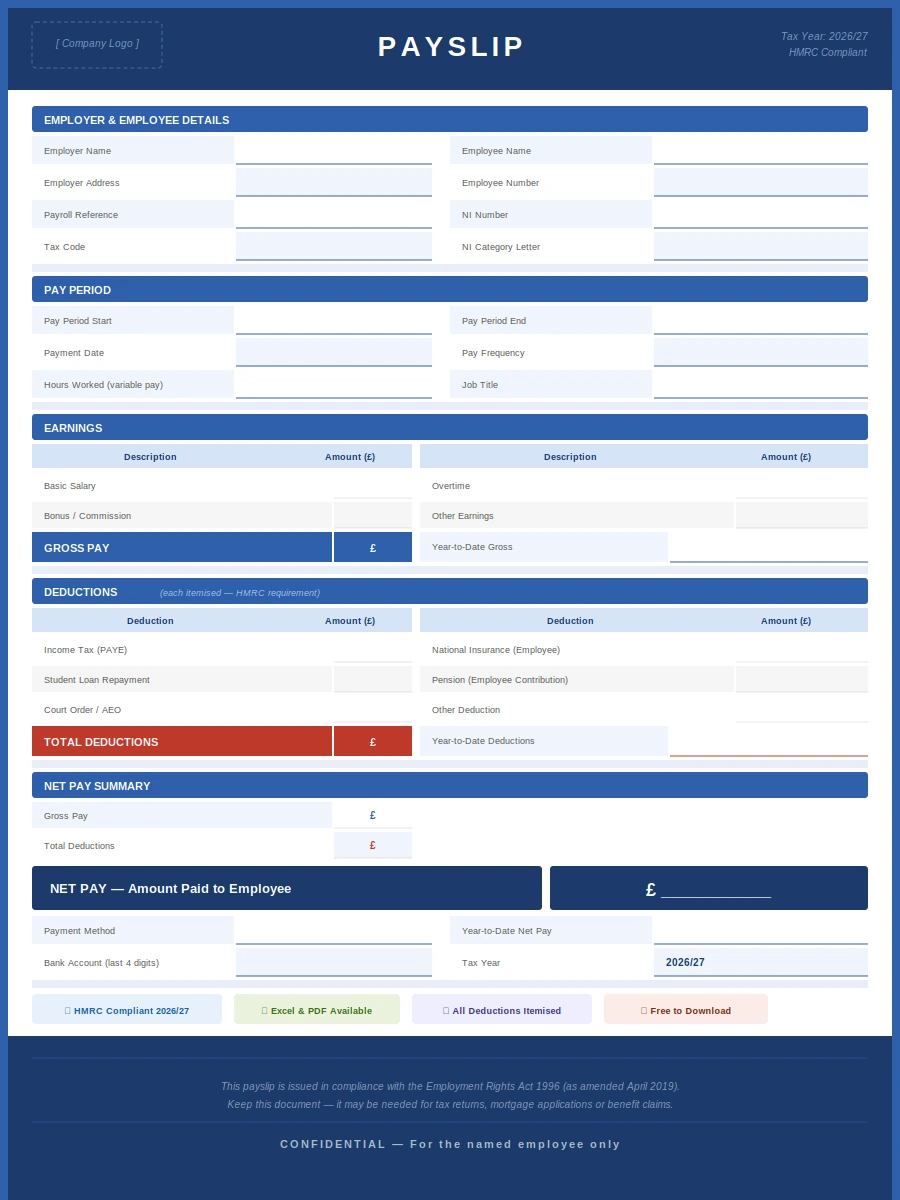
Once you’ve downloaded the template, here’s exactly how to complete it accurately:
- Employee details: Full name, NI number, and tax code (from their P45 or HMRC notice)
- Pay period: Start date, end date, and payment date
- Gross pay: Total before deductions: salary, overtime, bonuses, commission
- PAYE tax: Calculate and enter as a deduction (see section below)
- National Insurance: Employee NI contribution only; employer NI goes in your accounts separately
- Other deductions: Pension, student loan, court orders — each listed on its own line
- Net pay: Gross minus all deductions; this should match what hits their bank account
- Save and issue: Keep a copy and deliver to the employee on or before pay date
How to Calculate PAYE Tax on a Payslip
For most employees on a standard tax code (1257L Tax code), the process is:
- Find the tax-free allowance for the period. For a monthly payslip, divide the annual personal allowance (£12,570) by 12 = £1,047.50 per month.
- Subtract the tax-free amount from gross pay. E.g., £3,000 gross − £1,047.50 = £1,952.50 taxable pay.
- Apply the basic rate. £1,952.50 × 20% = £390.50 PAYE deduction.
This is a simplified calculation. Tax codes that aren’t 1257L (emergency codes, K codes, or those with adjustments) change the calculation.
How to Calculate National Insurance Contributions
Employee NI contributions for 2026/27 (Class 1, Category A):
- No NI on earnings below the Primary Threshold: £242/week or £1,048/month
- 8% NI on earnings between the Primary Threshold and Upper Earnings Limit (£967/week or £4,189/month)
- 2% NI on earnings above the Upper Earnings Limit
Example: An employee earns £3,000/month.
- NI-free: £1,048
- NI at 8%: (£3,000 − £1,048) = £1,952 × 8% = £156.16 employee NI
For anything more complex, HMRC’s Basic PAYE Tools will give you an accurate figure that accounts for year-to-date earnings and NI category, or simply use our Employee NI calculator.
Common Payslip Mistakes (and How to Avoid Them)
As an experienced HR Professional and after years of reviewing payroll for small businesses, below are the common mistakes you should avoid:
Using the wrong tax code. The default code is 1257L, but new starters without a P45, employees with multiple jobs or those with HMRC adjustments may have a different code. If you use the wrong code, the wrong tax can be deducted, and the employee gets a bill at year’s end. Always check the P45 or the HMRC new starter checklist, and update codes when you receive a P6 or P9 notice from HMRC.
Grouping deductions instead of itemising them. Showing “Total deductions: £450” without breakdown is a legal compliance failure since 2019. Every deduction needs its own line.
Forgetting hours worked for variable pay. Must show the number of hours worked on the payslip if an employee’s pay varies by hours including zero-hour workers. Omitting this is now a statutory breach.
Not updating for the new tax year. You have to review your template at the start of every tax year to ensure it aligns with the new tax year dates. A payslip template set up in April 2023 may be using outdated figures.
Issuing payslips after the payment date. Late payslips, even by a day, are technically non-compliant. Build issuing payslips into your payroll process, not as an afterthought.
No record-keeping system. Employers must keep payroll records for at least three years (HMRC recommends longer). If you can’t produce a payslip from two years ago, you have an exposure.
Payslip Templates vs Payroll Software – Which Do You Need?
This is the question I get asked most often, and the honest answer depends on your business size and growth plans.
| Payslip Template | Payroll Software | |
|---|---|---|
| Cost | Free | £5–£30/month typically |
| HMRC RTI filing | Manual (HMRC Basic PAYE Tools, free) | Automated |
| Payslip generation | Manual | Automated |
| Auto-enrolment pension | Manual calculations | Often integrated |
| Year-end (P60s, P11Ds) | Manual | Automated |
| Best suited for | 1–4 employees | 5+ employees |
| Error risk | Higher (manual) | Lower (automated) |
| Time per payroll run | 30–60 mins | 5–15 mins |
A good payslip template combined with HMRC’s free Basic PAYE Tools for RTI submissions is entirely workable for businesses with up to four employees and a simple pay structure (fixed salaries, standard deductions). But for businesses with five or more employees who have multiple pay frequencies, auto-enrolment pension management, or complex deductions, the time-saving and error reduction from proper payroll software quickly justifies the cost.