Best HR Software for Startups in the UK (2026)
As a startup founder, HR processes feel more challenging when your team grows to 15+ employees. You probably have to wear many hats and handle all tasks manually, while you can use HR software to take the burden off.
In this article, we’ve tested and reviewed the best HR software for startups available in the UK and how to choose the perfect one in 2026. Let’s have a look at what we found.
What is HR Software for Startups?
HR software is basically a digital tool that helps you manage your people. It stores employee information, tracks holidays and sick days, runs payroll, helps with hiring, and handles onboarding. For startups, the most important features are usually:
- Payroll processing: Calculating wages, taxes and National Insurance. For UK businesses, this means RTI submissions to HMRC. Automation helps a lot because getting this wrong is expensive.
- Time tracking and attendance: Logging who’s in, who’s off and who’s working remotely. You don’t have to chase people to fill in timesheets because good software does this automatically.
- Employee onboarding: Sending contracts, collecting documents and setting up accounts. A proper onboarding flow means new starters feel welcome and legal requirements get ticked off without any chasing.
- Performance management: Setting goals, running reviews, tracking feedback. Performance management is not essential from the first day but you’ll want it as you grow.
What UK Startups Actually Need in HR Software
Most HR guides available today are USA-specific but here’s what actually matters for UK and Irish startups.
GDPR and UK Data Protection
Make sure your HR software is UK-GDPR compliant and stores data on UK or EU servers because you’re storing personal data such as employee names, salaries, addresses, and performance records. Under UK GDPR, you’re responsible for how that data is handled.
UK Holiday and Absence Management
UK employees are entitled to 28 days of statutory annual leave including UK bank holidays. Your tool should understand this by default. It should calculate entitlement automatically, handle pro-rata for part-time staff, and let employees book leave without needing to email anyone.
PAYE and RTI Payroll Compatibility
If you run a UK payroll, you need to submit Real Time Information (RTI) reports to HMRC every time you pay someone. Many HR tools leave this to a separate payroll tool. Some, like Zelt, have this built in. Know what you’re getting before you sign up.
Scalability
For founders, it’s important to know that you might be 8 people today but in 18 months, you could be 40. So, the software you choose should grow with you and not force you to migrate everything to a new system or suddenly tripling in cost.
Ease of Implementation (Without an HR Team)
In startups, HR work is mostly done by the founder or an office manager. Your HR software needs to be set up in a day or two, not six weeks with a consultant.
Employee Self-Service
Employee self-service saves you hours every week. Employees should be able to view their payslips, book holidays, update their details and submit expenses themselves.
Benefits of Using HR Software as a Startup
There are several benefits of using human resource software for startups, especially in the UK. Let me share few of them:
Reduces Admin and Human Error
Manual processes create mistakes. Sometimes, a holiday is not recorded and sometimes a payslip has the wrong hours. A new starter doesn’t get their induction done because nobody remembered. HR software automates all of this and the chance of something being forgotten drops significantly.
Ensures Compliance with UK Employment Law
UK employment law has specific requirements around payslips, holiday entitlement, RTI submissions and data protection. If you have a good HR tool, it handles most of this automatically and you’re less likely to fall foul of HMRC or the ICO.
Improves Employee Experience
Employees feel more happier when they can book their own holidays, view their payslips and update their details through the HR dashboard without emailing HR. It feels like a proper company. That matters for retention, especially in competitive hiring markets.
Scales with Your Team
Good HR software grows with you. That means, the tools you use at 10 people should still work at 50. You don’t have to migrate everything to a new system every time you hit a headcount milestone.
Top HR Software for Startups: Quick Comparison
Here is a quick comparison of the best HR software for startups in the UK:
| Tool | Best For | Starting Price | UK Payroll | G2 Rating |
|---|---|---|---|---|
| Zelt | UK startups — HR + payroll combined | £5/employee/mo | ✅ Native | 4.8 |
| BambooHR | Growing teams with complex structures | £6/employee/mo | ❌ Integration | 4.5 |
| HiBob | Culture-focused teams | Custom | ❌ Integration | 4.5 |
| Personio | European/UK compliance | Custom | ✅ Available | 4.3 |
| Rippling | Tech startups, US + UK | Custom | ✅ Available | 4.8 |
| Deel | International hiring | $49/contractor | ❌ EOR model | 4.8 |
| BrightHR | Bricks-and-mortar small businesses | £3/employee/mo | ❌ Separate | 4.3 |
| Gusto | Payroll-first startups | $40/mo + per head | ❌ US only | 4.5 |
| CharlieHR | Very early stage UK startups | £4/employee/mo | ❌ Integration | 4.4 |
| Breathe HR | Global hiring for remote-first startups | From $29/mo per contractor | ❌ EOR model | 4.4 |
10 Best HR Software for Startups in the UK (2026)
Here is a detailed overview of the 10 best HR software for startups available in the UK in 2026. Check each one and find which fits your business best.
1. Zelt: Best All-in-One HR + Payroll for UK Startups
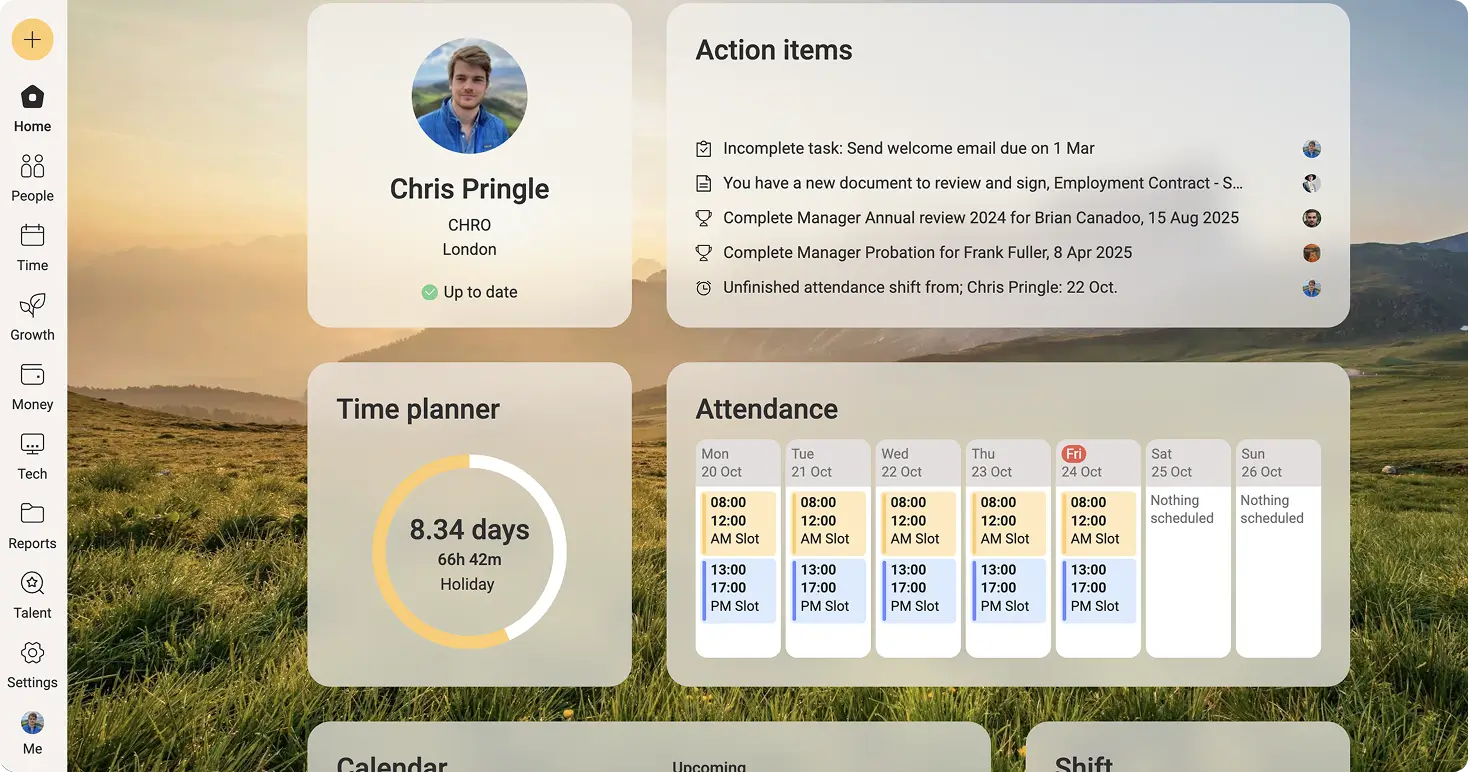
Zelt is built specifically for UK companies. Most HR tools make you connect to a separate payroll provider. Zelt has payroll built in, PAYE, pension auto-enrolment, the lot. It covers everything a growing startup needs. Onboarding, time off management, performance reviews, expenses and a proper employee app.
Key features:
- Native UK payroll
- Auto-enrolment pension management
- Holiday and absence tracking (UK statutory leave built in)
- Onboarding workflows
- Expense management
- Employee self-service app
- GDPR-compliant, UK data storage
Pricing: Zelt pricing starts from £5 per employee per month. You can Book a demo.
Limitations: Newer in the market than some traditional vendors
Best for: UK startups that want HR and payroll managed in one tool, without stitching together multiple integrations.
See how Zelt brings payroll, HR, and people management together in one connected platform.
2. BambooHR — Best for Teams with Complex HR Structures
BambooHR is one of the most popular HR tools in the world. And for good reason — it’s powerful, well-designed, and has been around long enough to iron out most of the rough edges.
Key features:
- Detailed employee records and org charts
- Applicant tracking system (ATS) included
- Onboarding and offboarding workflows
- Performance management and goal tracking
- Time and attendance tracking
- Integrates with most UK payroll tools (Sage, Xero, etc.)
Pricing: From around £6 per employee per month, depending on modules.
Limitations: Payroll is US-only natively. UK users need a separate payroll integration. Can feel like overkill for very small teams.
Best for: Startups of 20+ employees that want a proper, structured HR system and don’t mind setting up a payroll integration.
3. HiBob (Bob) — Best for Culture-Focused Teams
HiBob, usually just called Bob, has built a strong following among tech startups and scale-ups. It puts company culture and employee experience at the centre of everything.
Key features:
- People analytics and workforce insights
- Employee engagement and culture tools
- Onboarding and lifecycle management
- Compensation management
- Integrates with Slack, Greenhouse, Workday, and many others
- GDPR compliant, EU data storage available
Pricing: Custom pricing, usually starting around £6–8 per employee per month.
Limitations: Pricier than most alternatives. No native UK payroll. Implementation can take 4–6 weeks for larger teams.
Best for: VC-backed startups and scale-ups that care about culture, retention, and people analytics.
4. Personio — Best for European Startups with UK Offices
Personio is the go-to HR tool for European companies. It was built in Germany, so it understands European employment law, GDPR, works councils, multi-country compliance, in a way that US tools often don’t.
Key features:
- Multi-country HR management
- UK and EU payroll support
- Recruiting and applicant tracking
- Time tracking and absence management
- Document management with e-signatures
- Strong compliance features for EU employment law
Pricing: Custom pricing. Typically higher than BambooHR or Zelt. Worth requesting a demo before committing.
Limitations: More expensive for very small teams. Can be complex to configure. Some UK users report the UK-specific features lag behind the EU ones.
Best for: Startups with employees in multiple European countries, or companies expecting to expand into Europe soon.
5. Rippling — Best for Tech Startups Running Global Teams
Rippling does more than HR. It also manages IT — software licences, device management, app access. So when someone joins your company, HR and IT are set up at the same time. When someone leaves, both are shut down together.
Key features:
- HR, IT, and payroll in one platform
- Global payroll (including UK)
- Device and app management
- Automated onboarding workflows
- Advanced reporting and analytics
- 500+ integrations
Pricing: Custom pricing, typically starting around £7–10 per employee per month depending on modules.
Limitations: Expensive for small teams. The full power of Rippling only shows when you use the HR + IT modules together. Setup can take several weeks.
Best for: Tech startups of 20+ people, especially those with remote or international teams.
6. Deel — Best for Hiring International Contractors and Employees
Deel solves a specific problem: hiring people in other countries legally. If you want to hire a developer in Poland or a marketer in Brazil, Deel handles the contracts, payroll, and local compliance. You don’t need to set up a legal entity in every country. Deel acts as the Employer of Record.
Key features:
- Employer of Record (EOR) in 150+ countries
- Contractor management and payments
- Compliance in local employment law
- Global payroll and currency support
- Equity management tools
- HR tools for full-time employees included
Pricing: From $49/month per contractor, $599/month per EOR employee. HR platform available separately.
Limitations: Expensive if you have a lot of international employees. Not ideal as a standalone HR tool for purely UK teams.
Best for: UK startups hiring internationally, or any company managing a mixed team of contractors and employees across countries.
7. BrightHR — Best for Small Bricks-and-Mortar Businesses
BrightHR is built for small UK businesses that don’t have any HR expertise in-house. It’s simple, affordable, and very easy to set up.
Key features:
- Rota and shift scheduling
- Holiday and absence management
- Document storage
- UK employment law guidance included
- HR advice line (on higher plans)
- Simple employee app
Pricing: From £3 per employee per month.
Limitations: Limited on analytics and reporting. Performance management is basic. Not designed for fast-growing tech startups.
Best for: Small UK businesses with hourly workers, shift-based teams, or founders who want something simple with legal guidance built in.
8. Gusto — Best for Payroll-First Startups (US-Based)
Gusto is huge in the United States. Its payroll engine is excellent, benefits administration is smooth, and the interface is genuinely pleasant to use.
Key features:
- Best-in-class US payroll
- Benefits and health insurance administration
- Onboarding workflows
- Time tracking
- Contractor payments
Pricing: From $40/month base + $6 per person.
Limitations: No native UK payroll. Primarily designed for US market. International features are limited compared to Deel or Rippling.
Best for: US-based startups with UK employees who already use Gusto and want to extend it.
9. CharlieHR — Best for Very Early Stage UK Startups
CharlieHR is built for small UK companies. It’s affordable, simple, and covers the basics well. Holidays, documents, onboarding, performance reviews — it does all of it without being overwhelming.
Key features:
- Holiday and absence management
- Document storage and e-signatures
- Onboarding checklists
- Simple performance reviews
- UK employment contract templates included
Pricing: From £4 per employee per month.
Limitations: Doesn’t have payroll. Limited analytics. You’ll likely outgrow it by the time you hit 30+ employees.
Best for: UK startups under 20 people that are getting organised for the first time.
10. Oyster — Best for Remote-First Startups Hiring Globally
Oyster is built for startups that hire remotely across borders. If your team is spread across different countries — and you don’t want to set up legal entities everywhere — Oyster handles the compliance, contracts, and payroll locally in each country.
Key features:
- Employer of Record (EOR) in 180+ countries
- Contractor management and global payments
- Locally compliant employment contracts
- Benefits administration in each country
- Equity and bonus management
- Time off management across time zones
Pricing: From $29/month per contractor, $599/month per EOR employee.
Limitations: Not a full standalone HR tool for purely UK-based teams. No native payroll for domestic hires. Works out expensive if most of your team is in one country.
Best for: Remote-first UK startups that hire talent globally and want a simpler alternative to setting up foreign legal entities.
Still in search mode? Read our guides on:
- Best HR software for UK businesses
- Best payroll software for UK businesses
- Top HR and payroll software in UK 2026
How to Choose the Right HR Software for Your Startup
To choose the right HR management software, you should start with your biggest pain point, whether it’s payroll, time tracking or onboarding. Once you find your pain point then choose a tool that solves that first and everything else is a bonus.
Also, check for UK payroll compatibility. A lot of tools advertise global payroll but don’t actually support UK RTI submissions natively. Ask specifically about PAYE, RTI and pension auto-enrolment before signing up.
Think about your team’s technical ability. You should not go with a tool that requires a 6-week implementation if you’re a 10-person startup with no IT team. Prioritise tools with fast and self-serve setup.
HR software pricing is also an important factor to keep in mind. Calculate the real cost. Per-employee pricing adds up fast. A tool that costs £5 per employee per month is £300/month at 60 people. Model out what you’ll pay in 12 and 24 months, not just today. Finally, always book a demo or take the free trial.
Final Thoughts
Choosing the best HR software for startups depends on your business needs, team size, whether you need payroll built in, how quickly you want to get set up and how much you want to spend.
That said, for UK startups specifically, the most important thing is finding a tool that understands UK employment law. So after reviewing all tools, we believe that Zelt is built for exactly this. It handles UK payroll natively, manages statutory leave correctly and is fast to set up without an HR team. If you’re a UK startup looking for one tool that does it all, it’s worth starting with Zelt.
Frequently Asked Questions
Does Zelt have an ATS?
Yes. Zelt includes a built-in ATS (Applicant Tracking System). It also integrates with third-party ATS platforms, Teamtailor, Screenloop and Workable, if you prefer to retain an existing tool while using Zelt for HR and onboarding.