UK Bank Holidays 2026: Full List & HR Tips
Whether you’re an employee planning your annual leave or an HR professional juggling everyone’s time off requests, knowing all the UK bank holidays in 2026 makes life so much easier.
I’ve worked in HR for years now and trust me, the months around bank holidays are some of the busiest in any HR calendar. People want time off. Managers want cover. And payroll has its own headaches.
In this guide I’ll walk you through every UK bank holiday in 2026 across England & Wales, Scotland and Northern Ireland. And everything you need to know as an HR professional managing it all.
What Are UK Bank Holidays?
UK bank holidays are public holidays set by the government when banks and most businesses close. Employees usually get the day off but the rules around pay and whether you can be made to work depend a lot on what’s in your contract. A few important things you should know before we get into the dates:
Bank holidays aren’t the same across all four nations. Scotland and Northern Ireland do things their own way. England and Wales share the same dates.
Most bank holidays land on a Monday or Friday. Which is great for long weekends. If a bank holiday falls on a weekend, the following Monday becomes a substitute bank holiday. In 2026, we do have a couple of dates worth watching out for. More on those below.
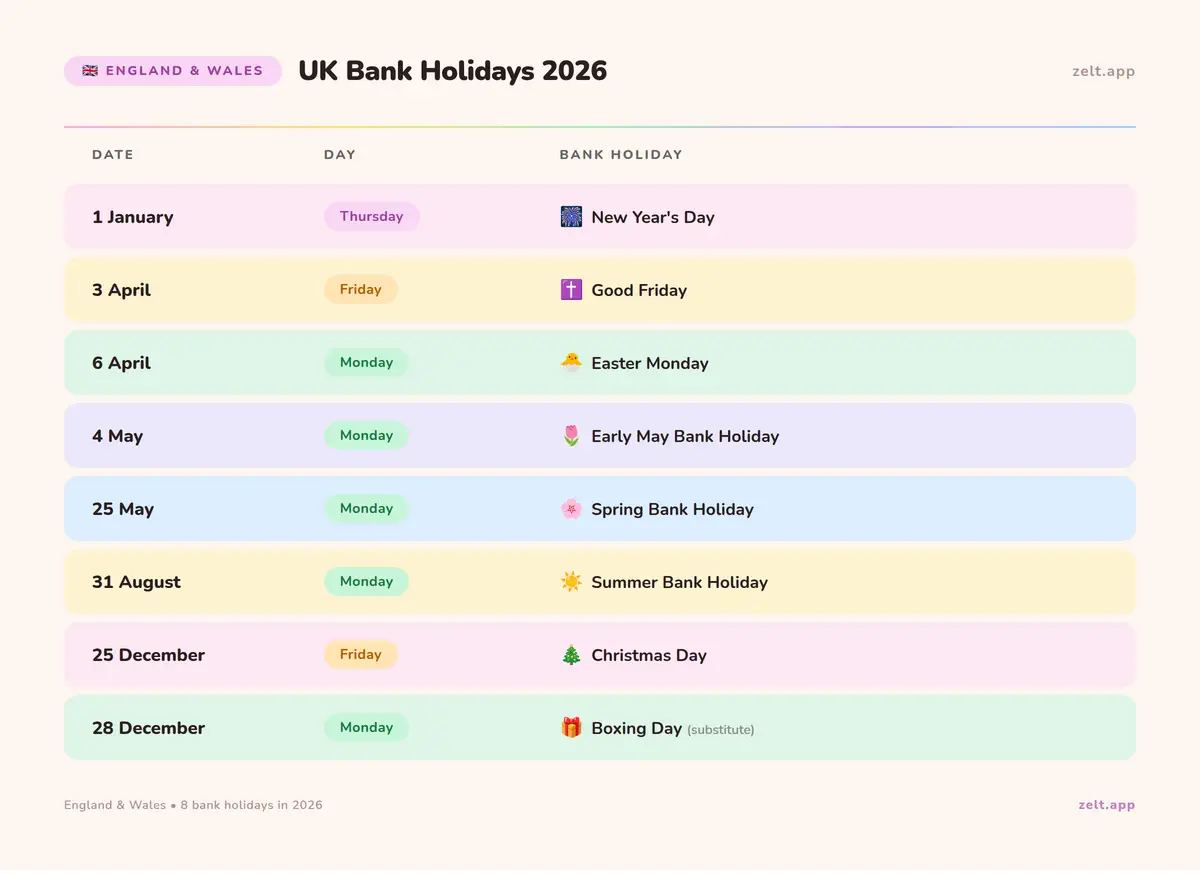
UK Bank Holidays 2026: England & Wales
| Date | Day | Bank Holiday |
|---|---|---|
| 1 January | Thursday | New Year’s Day |
| 3 April | Friday | Good Friday |
| 6 April | Monday | Easter Monday |
| 4 May | Monday | Early May Bank Holiday |
| 25 May | Monday | Spring Bank Holiday |
| 31 August | Monday | Summer Bank Holiday |
| 25 December | Friday | Christmas Day |
| 28 December | Monday | Boxing Day (substitute) |
A quick heads up. Boxing Day 2026 falls on a Saturday. So the substitute bank holiday moves to Monday 28 December. This is the kind of thing that always trips up payroll teams. So get it noted in your system early.
The spring and summer months (April, May, August) are still the busiest stretch for bank holidays. Which means they’re also the busiest months for annual leave requests. If you manage rotas, this is the period to plan for first.
See how Zelt brings bank holidays, leave, and payroll together in one connected platform.
UK Bank Holidays 2026: Scotland
Scotland gets 9 bank holidays. Two of them are unique to Scotland. The 2nd January and St Andrew’s Day.
| Date | Day | Bank Holiday |
|---|---|---|
| 1 January | Thursday | New Year’s Day |
| 2 January | Friday | 2nd January |
| 3 April | Friday | Good Friday |
| 4 May | Monday | Early May Bank Holiday |
| 25 May | Monday | Spring Bank Holiday |
| 3 August | Monday | Summer Bank Holiday |
| 30 November | Monday | St Andrew’s Day |
| 25 December | Friday | Christmas Day |
| 28 December | Monday | Boxing Day (substitute) |
Worth noting. Scotland doesn’t observe Easter Monday. So if you’ve got a team split between England and Scotland, you’ll have folks in Glasgow at work while London is closed. I’ve had this exact situation come up loads of times. It causes confusion every single year. Best to communicate it clearly in advance.
Also Scotland’s Summer Bank Holiday is on the first Monday of August. England and Wales have it on the last Monday. Different month entirely.
UK Bank Holidays 2026: Northern Ireland
Northern Ireland has 10 bank holidays. The most of any UK nation. They include St Patrick’s Day and the Battle of the Boyne.
| Date | Day | Bank Holiday |
|---|---|---|
| 1 January | Thursday | New Year’s Day |
| 17 March | Tuesday | St Patrick’s Day |
| 3 April | Friday | Good Friday |
| 6 April | Monday | Easter Monday |
| 4 May | Monday | Early May Bank Holiday |
| 25 May | Monday | Spring Bank Holiday |
| 13 July | Monday | Battle of the Boyne (substitute) |
| 31 August | Monday | Summer Bank Holiday |
| 25 December | Friday | Christmas Day |
| 28 December | Monday | Boxing Day (substitute) |
A quick note on the Battle of the Boyne. The actual date is 12 July. But in 2026 that falls on a Sunday. So the bank holiday moves to Monday 13 July.
If your team spans the UK, this is one of those dates where Northern Ireland is closed and the rest of the country is working. Easy to forget.
How Bank Holidays Affect Annual Leave Entitlements
This is where things get tricky. So pay attention.
Full-time Employees
Full-time employees in the UK get a minimum of 28 days of paid annual leave per year. That’s 20 statutory days plus 8 bank holidays for England and Wales.
But here’s the thing that catches people out. How bank holidays are treated depends entirely on what your contract says.
“28 days including bank holidays” — Bank holidays count towards your allowance. You don’t get extra days on top.
“28 days plus bank holidays” — You get 28 days of leave plus all the bank holidays. This is more generous.
This single sentence in your contract makes a massive difference to how much time off you actually get. I cannot tell you how many disputes I’ve had to sort out over this. Always check your contract carefully.
If you’re an HR professional reading this, please make sure your handbook is crystal clear on this. Ambiguous wording is the number one cause of bank holiday disputes I’ve come across.
Part-time Employees
Part-time employees get a pro-rated share of bank holidays based on how many days a week they work.
For example, an employee working 3 days a week in England would get:
3 ÷ 5 × 8 = 4.8 days of bank holiday entitlement
Important point. This pro-rata applies even if the part-timer never works on a Monday. Some managers think someone who never works Mondays gets nothing. That’s wrong. They still get the pro-rated allowance and it can be taken as alternative time off.
Honestly, this is one of the most common payroll mistakes I see in small businesses. Worth getting right.
Do You Get Extra Pay for Working on a Bank Holiday?
Quick answer. No. Not automatically. UK law doesn’t require employers to pay extra (like time and a half or double time) for bank holiday work. Whether you get a higher rate is entirely down to your contract or company policy.
What the law does say is that your total pay across the year can’t drop below the National Minimum Wage. Including hours worked on bank holidays.
If your contract doesn’t mention bank holiday pay, it’s worth raising with your manager or checking your handbook. Some employers offer:
- Enhanced pay rate (often time and a half or double time)
- Time off in lieu (TOIL) — basically a swap day off
- No enhancement at all — just standard pay
Be honest with your team about this. Nothing creates resentment faster than someone finding out on Christmas Day they’re not getting extra for working.
Tips for Planning Leave Around Bank Holidays
Whether you’re booking time off or trying to keep the business running, these tips actually help.
For Employees
Use the bank holiday bridge. Taking 4 days off around Easter (Good Friday and Easter Monday) gives you a 9-day break using only 3 days of leave. Brilliant return on investment.
Book May leave early. The two May bank holidays fill up fast. Get your request in by February or March if you can.
Check regional differences. If your colleagues are in Scotland or Northern Ireland, their bank holidays might be different from yours. Useful to know if you’re trying to schedule a meeting or project deadline.
For HR Managers and Business Owners
Review staffing in April, May and August first. These three months carry the most bank holidays and the most annual leave requests. They’re the trickiest months by far.
Set your holiday approval policy early. First-come-first-served is simplest. But a rota system can be fairer for customer-facing teams. Either way, decide before bank holiday season starts.
Get part-time entitlements right. Pro-rata calculations are easy to mess up if you do them by hand. Your leave management system should handle this automatically.
Be clear in contracts. The “including vs plus” bank holiday wording needs to be obvious in every contract you issue. No room for interpretation.
What Small Business Owners and HR Professionals Need to Know About Bank Holidays
Running bank holidays in a small business is harder than in a big company. You don’t have layers of cover. Every absence hurts more. Here’s what to keep in mind.
Legal obligations.
You’re not legally required to give bank holidays off unless it’s in the contract. But every employee gets 28 days minimum annual leave per year, and bank holidays count within or on top of that depending on how the contract is written.
Staffing gaps.
When bank holidays cluster in April, May and August, multiple staff will request leave at the same time. Set your approval rules before these months arrive. Don’t wait until everyone’s already asking.
Part-time fairness.
Pro-rata calculations are a common compliance trip-up in small businesses. If you don’t get this right, you could face a tribunal claim. Worth taking seriously.
Payroll implications.
Bank holidays affect pay calculations for hourly workers and shift workers especially. Make sure your payroll system flags these dates in advance, not after the fact.
Contract clarity.
The biggest source of bank holiday disputes I’ve seen is unclear contract wording. Get your contracts reviewed if you’ve not done it in a while.
Looking Ahead: UK Bank Holidays 2027
Already thinking about 2027? Good. Smart HR teams plan early. The remaining bank holidays in 2026 after summer are:
- 25 December (Friday): Christmas Day
- 28 December (Monday): Boxing Day (substitute)
For 2027, most UK bank holidays will again fall in spring and summer (April, May, August). That pattern is consistent year to year. Getting your leave management system updated with 2027 dates by January is the easiest way to avoid the panic that hits a lot of teams every new year.
How Zelt Helps HR Teams Manage Bank Holidays Better
Managing bank holidays manually eats hours every year. Spreadsheets go out of date. Pro-rata calculations get done wrong. And someone always books the same Monday as three others on their team.
This is where Zelt comes in. It’s an all-in-one HR platform built for UK businesses. And it takes most of the bank holiday headache off your plate. Here’s how it helps:
- Region-aware bank holiday calendars for England, Wales, Scotland and Northern Ireland. So if your team is split across the UK, everyone sees the right dates.
- Automatic pro-rata calculations for part-time staff. Change someone’s working days and the system recalculates instantly.
- Clear leave dashboards so you can spot staffing gaps in April, May and August before they become problems.
- Approval workflows that run in the background once you set your rules.
- Connected HMRC-recognised payroll so bank holiday pay flows through automatically. No manual entry.
- Self-service for employees to check balances and book leave from their phone.
If you’re still managing bank holidays in a spreadsheet (and a lot of UK small businesses are), it’s worth a look. You can book a demo today !
Frequently Asked Questions
Can Your Employer Make You Work on a Bank Holiday?
Yes they can. Unless your contract specifically says you have the right to take bank holidays off, your employer can ask you to work. This is normal in many sectors. Hospitality. Retail. Healthcare. Transport. These industries don't really stop for bank holidays. If you're required to work, you still get your full annual leave allowance (28 days minimum). And any enhanced pay your contract promises.
How Many UK Bank Holidays Are There in 2026?
The number depends on which part of the UK you're in.
- England & Wales: 8
- Scotland: 9
- Northern Ireland: 10
Same totals as 2025. But the dates shift around because of how the calendar falls. Let me break each one down.
When Are the May Bank Holidays in 2026?
There are two May bank holidays in 2026 across all four UK nations:
- Early May Bank Holiday: Monday 4 May 2026
- Spring Bank Holiday: Monday 25 May 2026
These are some of the most popular days for employees to book extra leave. People often take the four days between them to create a long break. So if you manage holiday approvals, get your policy sorted by March at the latest. I've seen teams get caught out by this every single year. May bank holidays come around fast. And by the time someone realises they need to book cover, half the team is already on leave.
When Do Most Bank Holidays Occur in 2026?
Most UK bank holidays in 2026 cluster in three months. April, May and August.
- April brings Good Friday and Easter Monday for England, Wales and Northern Ireland.
- May has two Monday bank holidays. The Early May Bank Holiday on the 4th. And the Spring Bank Holiday on the 25th.
- August closes out the summer with the Summer Bank Holiday on the 31st (or 3rd in Scotland).
Why does this matter? Because these three months are when annual leave requests pile up. Everyone tries to bridge a bank holiday with a few extra days off. If you don't have a clear approval process, you'll end up with chaos. Or worse, an empty office.
What is the difference between a bank holiday and a public holiday?
These terms are often used to mean the same thing in the UK. But in technical terms, a bank holiday is a day when banks are legally required to close under the Banking and Financial Dealings Act 1971. A public holiday is a wider term that includes bank holidays and other cultural or regional days off.
Is New Year's Day 2026 a bank holiday?
Yes. 1 January 2026 is a bank holiday across all four nations of the UK. It falls on a Thursday.
Are UK bank holidays the same in Scotland as in England?
No. Scotland has different bank holidays. They observe 2nd January and St Andrew's Day. They don't observe Easter Monday. And their Summer Bank Holiday is the first Monday in August, not the last.
What happens if a bank holiday falls on a weekend?
If a bank holiday falls on a weekend, the next working day becomes a substitute bank holiday. In 2026, Boxing Day falls on a Saturday. So the substitute is Monday, 28 December. Northern Ireland's Battle of the Boyne also moves from Sunday 12 July to Monday 13 July.
Can I include bank holidays within my 28-day annual leave entitlement?
Yes. Employers can count bank holidays towards the 28-day statutory minimum, as long as this is clearly stated in the contract.
How do I calculate bank holiday entitlement for a part-time worker?
Divide their working days per week by 5. Then multiply by the total bank holidays in your region. So a 3-day-per-week employee in England gets 3 ÷ 5 × 8 = 4.8 days.
Do I get paid extra for working on a bank holiday?
Not by law. Whether you get enhanced pay (time and a half, double time, etc) depends on your contract or company policy. Always check your handbook.