Best HR and Payroll Software for UK Businesses in 2026
If you are still managing HR and payroll in two separate tools, people management becomes more complex and leads you to costly payroll errors. But using HR payroll software keeps you in one place and saves your time, so you don’t have to chase data in both tools.
But with so many options available, choosing the best HR and payroll software for UK businesses in 2026 is genuinely difficult. All tools appear to be a perfect fit but after some time businesses realise they chose the wrong one. That’s why I’ve broken it all down here, what to look for, what to avoid and which platforms are actually worth your time in 2026.
What Is HR and Payroll Software?
HR and payroll software is basically a digital system that handles the administrative side of managing your people. Instead of switching between two separate tools, you can manage onboarding, time tracking and payroll in a single system. Integrated HR payroll systems help you to manage data in one place so any time you change salary, it automatically flows into payroll and you don’t need to change it manually.
Key Facts: HR and Payroll Software in the UK
- Around 65% of UK SMEs still manage payroll manually or with spreadsheets
- HMRC fines for payroll errors can start at £100 per employee for late RTI submissions
- The UK government issued £12.6 million in penalties to almost 800 employers for minimum wage failures, as reported by PKF Francis Clark in March 2026. It highlights the high financial risk of non-compliance.
- Businesses that switch to integrated HR and payroll platform report saving 4–8 hours per week on admin
- According to a 2026 QuickBooks survey, 27% of UK SME owners found hr and payroll software as one of the most useful digital tool for managing their workforce.
What Are the Benefits of Using Integrated HR and Payroll Software?
Look, you could keep using spreadsheets and a separate payroll bureau. Plenty of companies do. But here’s what you’re giving up if you don’t move to an integrated system.
Saves time with automated payroll processing
Running payroll manually is time-consuming. Even with a small team, it takes hours every month, pulling data from different places, double-checking numbers, submitting to HMRC. With automated payroll, most of that happens in the background. You review, approve, done.
Reduces compliance risk for UK employers
UK payroll compliance is not easy. You’ve got PAYE, National Insurance, Real Time Information (RTI) submissions, auto-enrolment for pensions, and now more employment law changes coming in 2026. A good platform handles all of this automatically so you’re not scrambling to keep up every time the rules change.
Improves the employee experience
This one gets overlooked a lot. When employees can see their own payslips, request leave, update their bank details, and check their benefits from a single app, they don’t need to email HR every five minutes. That’s better for them and better for your HR team.
At a Glance: Best HR and Payroll Software Comparison Table
Here is the quick comparison of the best HR and payroll software available in the UK:
| Platform | Best for | Pricing | UK Payroll | HMRC RTI |
|---|---|---|---|---|
| Zelt | All-in-one UK teams | From £8/employee/mo | ✓ | ✓ |
| Rippling | Remote-first teams | From £8/user/mo | ✓ | ✓ |
| Moorepay | Shift-based businesses | Custom pricing | ✓ | ✓ |
| Sage HR & Payroll | Small businesses | From £7/employee/mo | ✓ | ✓ |
| ADP Workforce Now | Larger businesses | Custom pricing | ✓ | ✓ |
| BambooHR | Employee management | Custom pricing | Via integration | ✗ native |
| Employment Hero | Growing SMEs | From £5/employee/mo | ✓ | ✓ |
Pricing correct as of mid-2026. Always check vendor websites for current rates.
The Best HR and Payroll Software for UK Businesses in 2026
I have spent a lot of time researching the top HR and payroll software UK in 2026 and tested several tools available in the market, and how well they actually handle UK-specific requirements like HMRC compliance and auto-enrolment. See the detailed overview below:
1. Zelt — Best HR and Payroll Platform for UK Teams
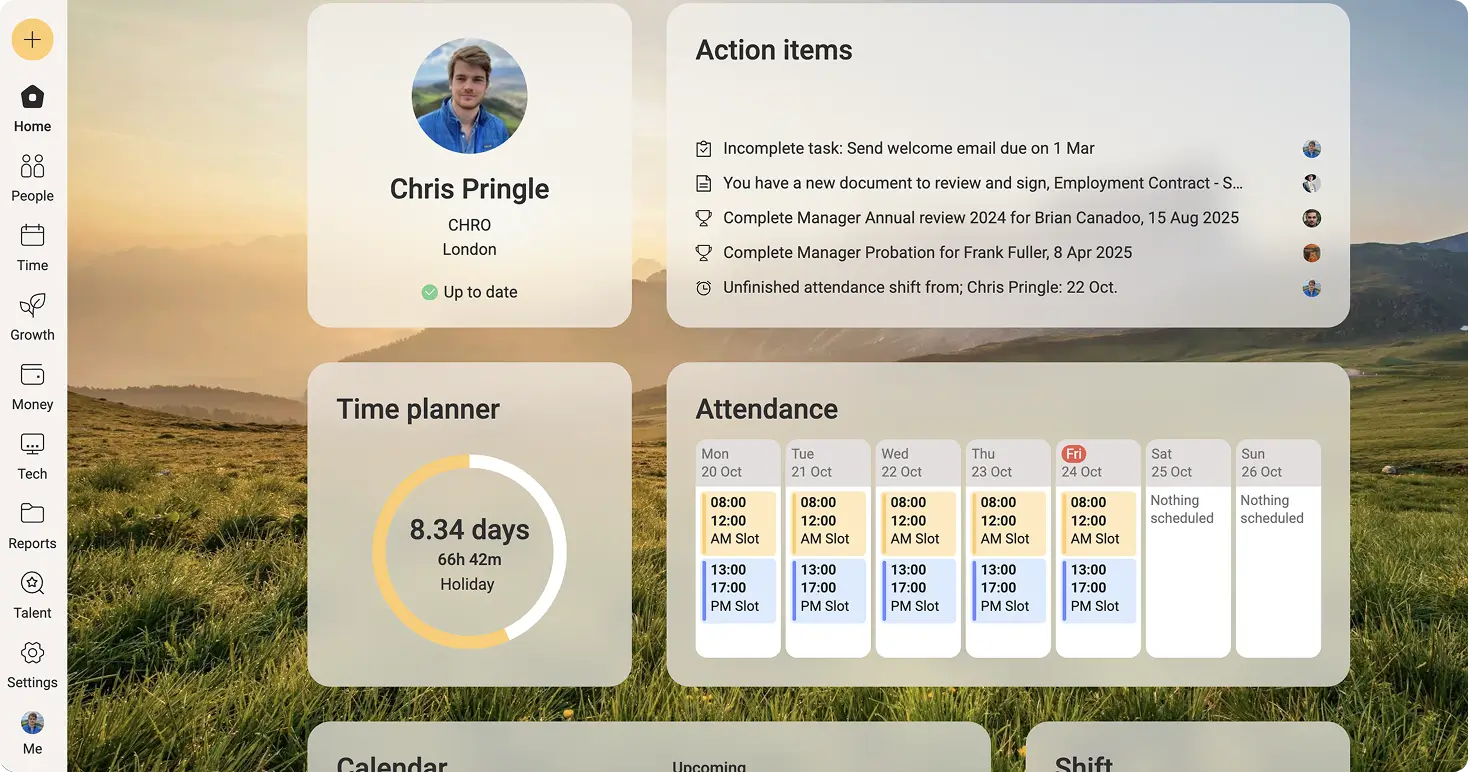
Zelt is a unified HR and payroll software built specifically for UK small to mid-sized businesses that want to manage everything from a single platform. Without the complexity (or the price tag) of some enterprise systems, it covers everything from onboarding and contracts to payslips and pension auto-enrolment. Zelt is one of the few platforms that feels genuinely designed for the UK market rather than adapted from a US product.
What I like most about Zelt is that it doesn’t feel like two separate tools glued together. The HR and payroll sides actually talk to each other properly, which sounds basic but honestly, a lot of platforms still get this wrong.
Key features
- Automated UK payroll software0 with RTI submissions to HMRC
- Integrated pension auto-enrolment
- Digital contracts and onboarding workflows
- Employee self-service app (leave requests, payslips, expenses)
- Benefits management, including health insurance and equity
- Time and attendance tracking
- Native applicant tracking system (ATS)
- Reporting and analytics
Pricing
Zelt pricing starts from £5 per employee per month, depends on company size and selected products as it is a modular platform.
Who is Zelt best suited to?
Zelt works really well for UK and GCC businesses between 20 and 1000 employees that want one platform for everything. It’s particularly good for growing businesses that don’t want to manage several tools just to run HR.
Pros:
- Built for the UK market from the ground up
- Clean, easy-to-use interface
- Strong payroll automation with HMRC compliance built in
- Good onboarding and contract management
- Transparent pricing
Cons:
- Not ideal for very large enterprise businesses
See how Zelt brings payroll, HR, and people management together in one connected platform.
2. Rippling — Best for Remote-First and International Teams
Rippling is a US-founded platform that’s expanded well into the UK and it’s genuinely impressive for businesses managing employees across multiple countries. It not only integrates HR and payroll but also IT management, devices, and apps.
Key features
- Global payroll with UK PAYE and RTI support
- HR, IT, and finance in one platform
- Workflow automation for onboarding and offboarding
- Time tracking and expenses
- Benefits administration
- Strong app integrations (Slack, Google Workspace, etc.)
Pricing: Rippling starts from around £8 per user per month , add-ons extra.
Who is Rippling best suited to?
Remote-first teams, international businesses or companies that want tight HR and IT integration. It’s probably overkill if you’re a traditional office-based business that just needs simple payroll.
Pros:
- Exceptional for managing remote and distributed teams
- Deep automation capabilities
- Very strong integrations
- Good mobile experience
Cons:
- Can feel complex for smaller, simpler businesses
- Some UK-specific features are less polished than US-native ones
- Pricing adds up if you need multiple modules
3. Moorepay — Best for Businesses With Shift-Based Operations
Moorepay has been around in the UK market for a long time and handles complex payroll scenarios like shift patterns, variable hours, and commission structures really well. It’s not the flashiest platform, but it’s solid.
Key features
- Advanced payroll for complex pay structures
- Shift scheduling and time tracking
- UK compliance tools built in
- Employee self-service portal
- HR document management
- Access to HR advisory support
Pricing: Moorepay uses custom pricing based on business size and requirements. You’ll need to get a quote, but it’s generally positioned as a mid-market product.
Who is Moorepay best suited to?
Businesses in retail, hospitality, healthcare, or any sector where workforce scheduling and variable pay is common. Also a good option if you want some human support alongside the software.
Pros:
- Very strong on complex payroll scenarios
- Long track record in the UK market
- HR advisory support available
- Good for shift-heavy industries
Cons:
- Interface feels a bit dated compared to newer platforms
- Pricing can be high for smaller businesses
- Not as feature-rich on the HR side
4. Sage HR & Payroll — Best for Small Businesses Already Using Sage
If you are already using Sage for accounting, adding Sage HR and payroll is a natural next step. The integration between the two is tight and there’s a lot of UK accountants who already know it well.
Key features
- UK payroll with HMRC RTI submissions
- Leave and absence management
- Expense management
- Integration with Sage Accounting and Sage 50
- Reporting tools
- Employee self-service
Pricing: Starts from around £7 per employee per month for the combined HR and payroll package.
Who is Sage best suited to?
Small to medium UK businesses, especially those already in the Sage ecosystem. Also good for businesses that want a well-known, established brand they can easily get accountant support for.
Pros:
- Very familiar to UK accountants
- Tight integration with Sage Accounting
- Solid UK payroll compliance
- Good support network
Cons:
- Interface isn’t as modern as some competitors
- Can feel clunky for HR-heavy tasks
- Scaling up can get expensive
5. ADP Workforce Now — Best for Larger UK Businesses
ADP is one of the biggest payroll providers in the world and Workforce Now is their platform for mid to large businesses. It’s built to handle complex payroll at scale.
Key features
- Full UK payroll with HMRC compliance
- Time and attendance
- Benefits administration
- Workforce analytics and reporting
- Learning management
- Global payroll capabilities
Pricing: Custom pricing. Generally aimed at businesses with 50+ employees.
Who is ADP best suited to?
Medium to large UK businesses, companies with complex payroll requirements, or organisations that need global payroll capabilities alongside UK compliance.
Pros:
- Very robust and reliable
- Strong compliance tooling
- Good for complex, large-scale payroll
- Global capabilities
Cons:
- Expensive for smaller businesses
- Implementation can be complex
- Interface can feel dated
- Customer support quality varies
6. Employment Hero — Best for Growing UK SMEs
Employment Hero has grown a lot in the UK market over the last few years and it combines HR, payroll, benefits, and hiring tools in one platform at a competitive price.
Key features
- UK payroll with RTI submissions
- Recruitment and onboarding
- Employee benefits marketplace
- Leave and performance management
- Wellbeing and reward tools
- Certified HR document templates
Pricing: From around £5 per employee per month for the core platform, with payroll as an add-on.
Who is Employment Hero best suited to?
Growing UK SMEs, particularly those that care about employee experience and engagement alongside the core HR and payroll basics.
Pros:
- Good value for money
- Strong employee-facing features
- Built-in benefits marketplace
- Works well for rapidly growing teams
Cons:
- Payroll is an add-on, not always included in base price
- Some users report the reporting features could be more advanced
- Support can be slow during busy periods
7. BambooHR — Best for Employee Management (with a payroll caveat)
BambooHR is one of the most popular HR platforms globally and it’s genuinely excellent for the people management side of things. Just worth knowing upfront that its native payroll is US-only, so UK businesses will need a separate payroll integration.
Key features
- Excellent employee records and people management
- Performance management and reviews
- Onboarding workflows
- Time off tracking
- Reporting and analytics
- Integrates with UK payroll tools
Pricing: Custom pricing. Generally mid-market.
Who is BambooHR best suited to?
UK businesses that primarily want a strong HR platform and are happy to manage payroll separately. Good for businesses where HR operations are more complex than payroll.
Pros:
- Outstanding HR features and UX
- Very strong performance and people management tools
- Clean interface that employees like
- Good integration ecosystem
Cons:
- No native UK payroll
- You’ll need a separate payroll solution
- Can work out expensive when you factor in the payroll integration
Note: All information, pricing, and features mentioned in this article have been sourced from publicly available data and do not reflect Zelt’s views or opinions. We recommend verifying the latest details directly on their respective websites before making any decisions.
How to Choose the Right HR and Payroll Software for Your UK Business
Choosing the right software isn’t just about picking the one with the most features. It’s about picking the one that fits where your business is right now — and where it’s going.
Key features to look for
Here’s a baseline checklist of things that should be non-negotiable for any UK business:
- HMRC RTI submissions — automated, not manual
- PAYE and National Insurance calculations — must be accurate and up to date with current rates
- Pension auto-enrolment — integrated or at least connected to your pension provider
- Payslip generation — accessible by employees without calling HR
- Leave and absence management — with manager approval workflows
- Employee self-service — app or web portal for employees to manage their own data
- Audit trail — important for compliance, especially as you grow
Factors to consider: size, industry, and budget
A business with 15 employees has different needs to one with 200. Before you start booking demos, be honest with yourself about:
- Headcount now and in 12 months — don’t buy for today if you’re growing fast
- Pay complexity — do you have shift workers, commission structures, or contractors?
- Industry — some sectors (healthcare, hospitality) have specific scheduling needs
- Budget per employee — most platforms charge per person, so know your number before you talk to sales
How to migrate from a standalone to an integrated system
This is something a lot of businesses underestimate. Moving from your current system to a new one involves:
- Exporting your existing employee and payroll data cleanly
- Mapping that data to the new system’s format
- Running parallel payroll for at least one month to check everything is correct
- Training your HR and finance teams
- Communicating the change to employees
Most good vendors will support you through this process, but ask them specifically what data migration help they provide before you sign.
Questions to ask vendors before you sign
Before you commit, make sure you get answers to these:
- How do you handle HMRC updates and law changes, automatically or do we need to do something?
- What does the onboarding and implementation process look like?
- What happens if payroll fails on pay day?
- How long is the contract? Can we exit if it doesn’t work out?
- Is there a UK-based support team?
Still in search mode? Read our detailed guide on the top HR software in the UK 2026 for a broader overview of the tools available in the UK.
Common Mistakes to Avoid When Choosing HR and Payroll Software
A lot of businesses pick the wrong software not because the software is bad — but because they went into the decision without a clear picture of what they actually needed. Here are the mistakes I see most often.
Choosing based on price alone. The cheapest option is rarely the cheapest in the long run. If it doesn’t handle your payroll complexity properly, the time you spend manually fixing errors will cost more than a better platform would have.
Not testing the payroll specifically. A lot of platforms have great HR demos but the payroll module is where the real complexity sits. Always ask to see a payroll run, not just the employee dashboard.
Ignoring the employee experience. If your employees find the self-service portal confusing, they’ll ignore it and your HR team will still be getting emails about every payslip and leave request.
Not asking about UK compliance updates. Tax rates, NI thresholds, employment law, these change every year. Ask your vendor exactly how they handle regulatory changes and who is responsible for keeping the platform up to date.
Buying for your current headcount only. If you’re planning to grow, buy for where you’ll be in two years. Re-platforming payroll software is painful and expensive.
UK HR and Payroll Law Changes You Need to Know in 2026
This is something that a lot of software comparison articles skip, but it actually matters a lot for which platform you choose. Make sure whatever system you pick is already updated for these changes (or has a clear plan to update).
Changes already in effect (April 2026)
- National Living Wage increase: The NLW rose to £12.21 per hour for workers aged 21 and over from April 2025, with further adjustments in April 2026. Your payroll software should handle this automatically.
- National Insurance employer contributions: Employer NI rate increased to 15% from April 2025, with the secondary threshold dropping to £5,000. This changes your payroll costs significantly.
- Statutory pay increases: Statutory Sick Pay, Statutory Maternity Pay and other statutory payments are updated in April each year. Check your platform handles these automatically.
Upcoming changes (October 2026 and beyond)
- Employment Rights Bill: The biggest shake-up to UK employment law in decades. Key changes include day-one unfair dismissal rights, stronger rights for zero-hours workers, and changes to flexible working entitlement. The rollout is phased, with some provisions taking effect in late 2026 and others in 2027.
- Neonatal Care Leave: New entitlement of up to 12 weeks paid leave for parents of babies requiring neonatal care. Already in effect from April 2025, but if your system hasn’t been updated for this, that’s a problem.
- Changes to zero-hours contracts: The Employment Rights Bill includes requirements to offer guaranteed hours to eligible zero-hours workers. This will impact scheduling and payroll for many businesses in hospitality and retail.
If you are evaluating software right now, ask each vendor specifically how they are handling the Employment Rights Bill rollout. Their answer will tell you a lot about how they handle compliance generally.
Zelt: The Right HR and Payroll Software for Your UK Business
If you are a growing UK business that wants to manage HR and payroll from one place and without paying enterprise prices then Zelt is built exactly for you.
From automated payroll and RTI submissions to digital contracts, onboarding and employee self-service, everything your team needs is in one platform. No jumping between two separate tools or last-minute payroll scrambles.
And because Zelt is built specifically for the UK market, you don’t have to worry about whether it handles HMRC compliance or the latest employment law changes. It does, automatically. Book a free demo and see how Zelt HR software works for your business.
Conclusion
Choosing the best HR and payroll software for your UK business is not a small decision. Get it right and your team saves hours every month, payroll runs without issues, and compliance takes care of itself. Get it wrong, and you are looking at data migrations and a switch six months down the line that nobody wants to deal with. Whatever platform you go with, make sure it handles UK compliance properly, the pricing is transparent and your employees can actually use it without calling HR for help.