Employment Rights Act: 2026 Changes
Employment law in the UK is undergoing one of its most significant transformations in decades. 2026 marks the beginning of sweeping changes that will impact employers and employees alike.
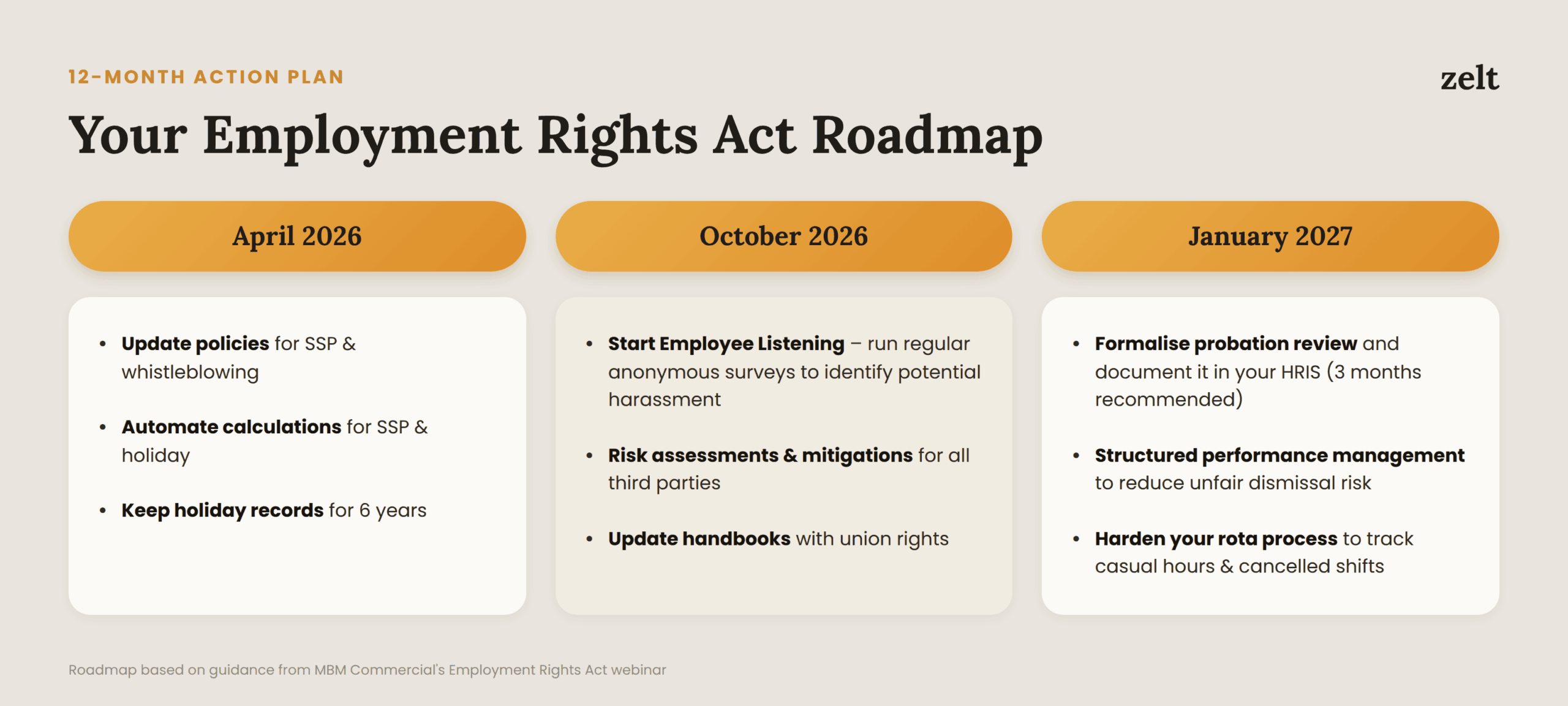
What’s Changing in 2026 and Beyond?
The Employment Rights Act and related legislation bring fundamental changes, including:
- Statutory Sick Pay (SSP) from day one of absence – no more waiting period
- Stronger duties to prevent sexual harassment, including third-party harassment
- Extended protections around redundancy and collective consultation
- Reduced qualifying period for unfair dismissal claims – down from 2 years to just 6 months
- New day-one rights for paternity and parental leave
- Strengthened whistleblowing protections
- New rights for bereaved partners
Individually, each change is manageable. Together, and on this timeline, they add up to a significant compliance lift for HR and people teams – particularly those still relying on spreadsheets, email threads, and manual processes to manage sick pay, holiday, policies, and employee feedback.
Where a Strong HRIS Makes the Difference
This is exactly the kind of moment where having a proper HRIS pays for itself. Here’s how Zelt (or any well-built HRIS) can directly support compliance with the incoming changes:
1. Automate SSP and holiday calculations
With SSP now due from day one, manual calculation errors become a real financial and legal risk. Automating these calculations in your HRIS ensures accuracy, removes hours of admin, and minimises the risk of underpayment penalties – while keeping the required six years of holiday records on file automatically.
2. Track casual worker hours for the 2027 changes
Ahead of the upcoming 2027 rules on compensation for short-notice shift cancellations, businesses with casual, zero-hours, or rota-based staff will need clear visibility into hours worked and cancelled. An HRIS that tracks this centrally makes it straightforward to calculate what’s owed – instead of piecing it together after the fact.
3. Run anonymous and semi-anonymous surveys
With stronger duties to prevent sexual harassment now in force, employers need to actively look for risk – not just wait for a complaint. Regular anonymous employee surveys, run through your HRIS, can surface potential issues by department before they escalate, giving you the early visibility that the new duty effectively requires.
4. Document policies and stay ahead of deadlines
Between updated whistleblowing and SSP policies, revised handbooks, and formalised probation and performance processes, there’s a lot to track. Centralising policy documentation and setting automated reminders in your HRIS means nothing slips through the cracks as deadlines approach.
Want to see how Zelt can help automate SSP, holiday, and compliance tracking ahead of the Employment Rights Act changes? Book a demo with our team →
Frequently Asked Questions
What is the Employment Rights Act?
The Employment Rights Act 2025 is a major piece of UK legislation that overhauls employment law across areas like sick pay, unfair dismissal, redundancy, whistleblowing, and workplace harassment protections. It received Royal Assent in 2025, with its various provisions being phased in through secondary legislation and codes of practice across 2026 and into 2027. In practice, it represents one of the most significant shifts in UK employment rights in decades, and applies to employers of all sizes.
When do the Employment Rights Act 2025 changes actually take effect?
The Act received Royal Assent in 2025, but it doesn't switch on all at once. Changes are being phased in through 2026 and into 2027 via secondary legislation and codes of practice — which is exactly why MBM's roadmap spreads action points across April 2026, October 2026, and January 2027 rather than a single deadline.
What does "day one" Statutory Sick Pay actually change for employers?
Currently SSP has a waiting period before it kicks in. Under the new rules, it becomes payable from the very first day of absence, with no qualifying wait. For payroll, this means more frequent, lower-value SSP calculations rather than fewer, larger ones — which is where manual tracking starts to strain and automated calculation really pays off.
Does the reduced unfair dismissal qualifying period mean any new hire can claim unfair dismissal?
Not immediately, however the qualifying period is dropping from 2 years of service to 6 months, so employees become eligible to bring an unfair dismissal claim much earlier in their tenure. This is why formalising probation reviews and having structured, documented performance management matters more than ever — decisions that used to be relatively low-risk in someone's first 18 months carry real exposure now.
What new duties do employers have around sexual harassment?
Employers now face a strengthened, proactive duty to prevent sexual harassment — including harassment from third parties like customers or clients, not just colleagues. It's no longer enough to respond to complaints; the expectation is that you're actively assessing risk (for example, through anonymous employee surveys) and putting mitigations in place before an issue arises.