Best HCM Software UK: Top 10 Picks for 2026
People management becomes expensive and chaotic when you manually handle HR and your tools don’t talk to each other. Many businesses use HCM software to manage the employee lifecycle more effectively. But choosing the right one can be complicated when there are so many options available.
That’s why we spent hours researching the best HCM software available for UK businesses in 2026. In this list, we compare their key features, pricing, pros and cons so you can see which HCM software fits your needs and budget.
10 Best HCM Software UK: Quick overview
If you don’t want to go into details, here’s a quick review of the best HCM Software systems in the UK for 2026.
| Software | Best for | Rating | Starting price |
|---|---|---|---|
| Zelt | Small to Mid-sized businesses UK companies that want HR and payroll in one place | 4.8/5 | From £5/user/month |
| Workday HCM | Large enterprises with complex global workforces | 4.1/5 (G2) | Custom pricing |
| Oracle Fusion Cloud HCM | Big enterprises already on Oracle systems | 4.8/5 (Gartner) | From £24/user/month |
| SAP SuccessFactors | Enterprises using SAP for finance or ERP | 3.9/5 (G2) | From £5/user/month |
| Dayforce | Mid to large companies needing strong payroll and workforce management | 4.2/5 (G2) | From £12/user/month |
| ADP Workforce Now | Mid-sized businesses that want a trusted payroll-first system | 4.2/5 (G2) | From £10/user/month |
| UKG Pro | Companies that need deep workforce management and scheduling | 4.3/5 (G2) | From £12/user/month |
| Rippling | Growing companies that want HR, IT, and finance connected | 4.8/5 (G2) | From £8/user/month |
| BambooHR | Small and mid-sized businesses wanting simple HR tools | 4.4/5 (G2) | From £7/user/month |
| Deel | Companies hiring internationally or managing contractors | 4.8/5 (G2) | From £25/user/month |
What is HCM software?
HCM (Human Capital Management) software is used to manage the full employee lifecycle. That usually includes things like payroll, core HR records, time tracking, performance reviews, benefits, recruiting, onboarding and workforce planning.
Your employees are not just names on a spreadsheet. They are an asset. The idea behind HCM is that it should help you manage that asset properly. As Josh Bersin, HR industry analyst, said, “HR is no longer just about policies and paperwork. It’s about building the systems that help people do their best work.” That’s really the whole point of HCM software, it’s not there to replace HR people, it’s there to give them the systems to actually do the job well.
HCM vs HRIS, HRMS, and ERP, what’s the difference?
HCM, HRIS, HRMS, and ERP are used interchangeably in the HR industry. But let me share their difference.
An HRIS (Human Resource Information System) is mainly focused on storing and managing employee data, things like personal details, contracts, and leave records. It’s more of a system of record. If that’s closer to what you need, take a look at our guide to the best HRIS software.
HRMS (Human Resource Management System) does a bit more than HRIS. It usually adds payroll and time tracking on top of the basic record keeping.
HCM takes it even further. It covers the full employee lifecycle, so recruitment, onboarding, performance, learning, succession planning, and workforce analytics, alongside the payroll and record-keeping bits. A good example of HCM software is Zelt.
ERP (Enterprise Resource Planning) is a bigger system altogether. It covers HR but also finance, supply chain, and operations, all connected together. Some platforms like Oracle and SAP offer both ERP and HCM products.
Why UK businesses need HCM software
Managing people is one of the biggest pain points for UK businesses. And this isn’t a small market you’re picking a tool in either. The global HCM software market is projected to grow from $31.47B in 2026 to $44.74B by 2030 at a 9.2% CAGR, according to Research and Markets (2026). More companies are investing in this space every year, which also means more choice, and more room to get it wrong if you don’t compare properly.
Businesses need to have their employee data in one place rather than across multiple spreadsheets. That’s why businesses use HCM platforms to keep all their data in one place.
UK payroll has its own quirks, from HMRC reporting and pension auto-enrolment to statutory sick pay and right to work checks that need to be done properly and on time. Get any of this wrong and you’re looking at fines or worse. A good software handles this in the background so you’re not manually checking rules every time legislation changes.
As your company grows, hiring five people a year can turn into hiring five people a month. Doing onboarding manually at that pace just doesn’t work. Paperwork gets missed, new starters don’t get set up on time and it looks unprofessional. A good HCM system lets you build a repeatable process so growth doesn’t mean more admin chaos.
How we evaluated these tools
We looked at how each platform actually performs for UK specific needs, like whether it runs UK payroll natively or needs a third party plugged in, how it handles right to work checks, and whether support is actually based in the UK or routed through a call centre in another time zone. We also looked at ease of setup, because a system that takes eight months to implement isn’t much use to a team that needs answers now.
Top 10 HCM Software systems in the UK [2026 edition]
Below is a closer look at the top UK HCM software platforms for UK businesses in 2026.
1. Zelt
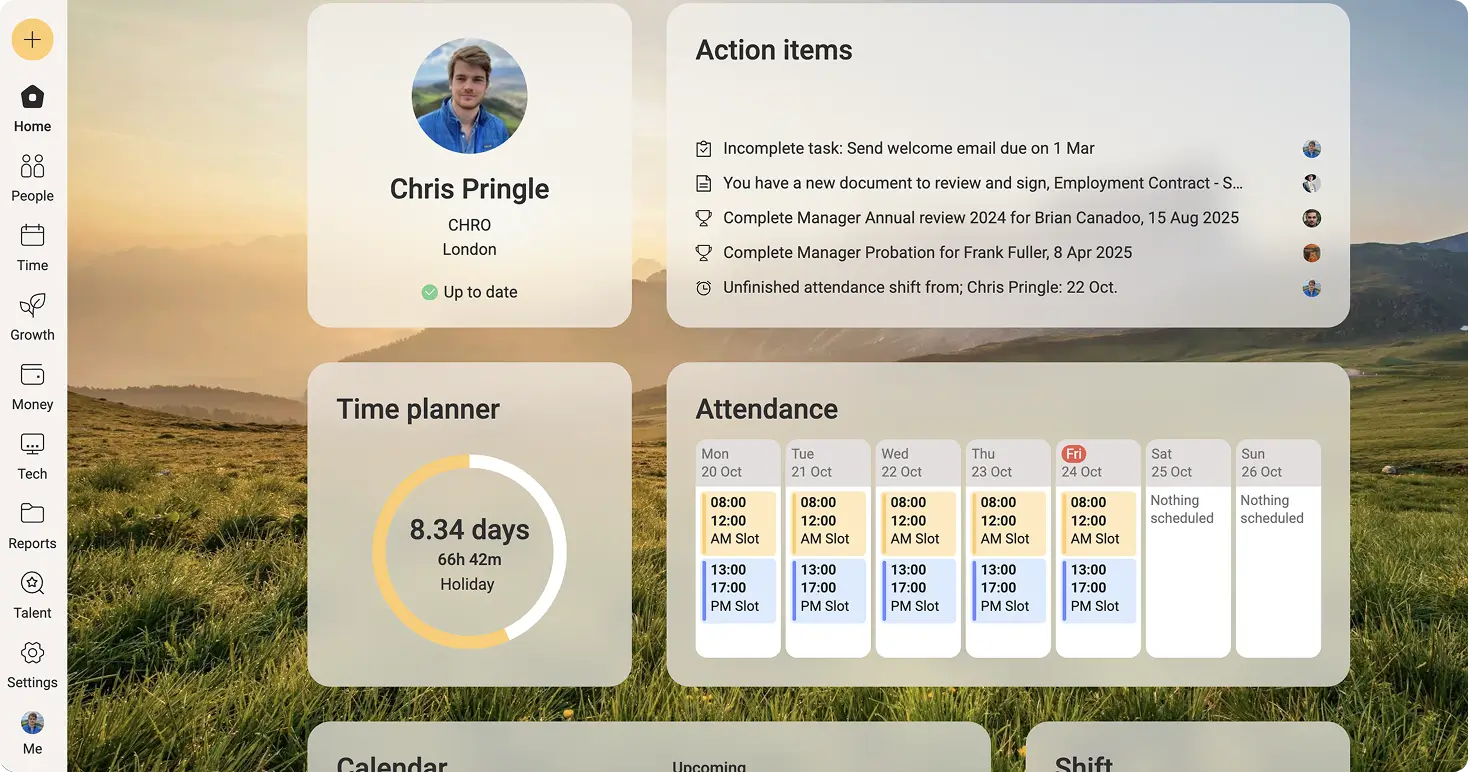
Zelt is built for companies that don’t want to juggle five different tools just to run HR. It brings HR, onboarding, and payroll together in one platform, so when someone joins the company, their laptop gets ordered, their software access gets set up, and their HR record gets created, all from one workflow instead of three separate ones.
Key features:
- HR and payroll managed from a single platform
- Automated onboarding and offboarding, including device and app provisioning
- Native UK payroll system, pensions, and HMRC compliance
- Real time employee data that syncs across departments
- Spend management and expense tracking built in
Pros:
- Saves a lot of admin time by connecting HR and Finance in one place
- Quick to set up compared to legacy enterprise systems
- Good for companies managing both UK and international staff
Cons:
- Newer to the market than some of the bigger legacy names, so it doesn’t have decades of case studies behind it yet
- Might be more than a very small team needs if they only want basic HR
Pricing: Pricing starts at £5/user/month. Zelt’s pricing depends on company size and selected products as it is a modular platform.
Speak to us to see how Zelt simplifies HR management with employee data, payroll, benefits, and analytics in one platform.
2. Workday HCM
Workday is one of the biggest names in HCM, used by a lot of large global enterprises. It’s a huge platform that covers HR, finance, and planning, and it’s built to handle complex organisational structures across many countries.
Key features:
- Deep workforce planning and analytics
- Strong support for complex, multi country organisations
- Talent management including performance and succession planning
- Configurable reporting dashboards
Pros:
- Very strong for large enterprises with complicated reporting lines
- Powerful analytics and forecasting tools
- Well established, so lots of documentation and community support
Cons:
- Can be overkill and expensive for small or mid sized businesses
- Implementation can take months and often needs a dedicated project team
- Interface can feel dense for everyday users
Pricing: Custom / quote-based, depending on size and modules.
3. Oracle Fusion Cloud HCM
Oracle Fusion is Oracle’s cloud based HCM suite, and it tends to suit companies that are already using other Oracle products, since it plugs in nicely with the wider Oracle ecosystem.
Key features:
- Full HR suite including payroll, talent, and workforce management
- AI powered insights for workforce planning
- Strong compliance tools for multi country operations
- Integrates well with other Oracle ERP modules
Pros:
- Good fit if you’re already in the Oracle ecosystem
- Solid for large, complex organisations
- Strong reporting and compliance features
Cons:
- Not the easiest system to learn if you’re new to it
- Implementation and support can be costly
- Might feel like too much system for smaller companies
Pricing: From £24/user/month, actual cost depends on which modules you pick, your headcount, and your region.
4. SAP SuccessFactors
SAP SuccessFactors is another enterprise heavyweight, often chosen by companies already running SAP for finance or operations. It covers the full employee lifecycle and is known for its learning and talent management tools.
Key features:
- Strong learning management and talent development tools
- Performance and goal management
- Workforce analytics and planning
- Integrates with SAP’s broader ERP systems
Pros:
- Good for companies that already run SAP elsewhere in the business
- Strong talent and learning features
- Scales well for large, global workforces
Cons:
- Can be complex to configure and maintain
- Not the most intuitive interface for day to day users
- Better suited to enterprise budgets than smaller teams
Pricing: From £5/user/month, based on which modules and how many employees you have.
5. Dayforce
Dayforce (formerly Ceridian) is known for its strong payroll and workforce management capabilities, especially for companies with shift based or hourly workers.
Key features:
- Real time payroll calculations
- Strong time and attendance tracking
- Workforce scheduling tools
- Single database architecture so data updates instantly across the system
Pros:
- Payroll accuracy is a real strength here
- Good for businesses with shift workers or complex scheduling needs
- Real time data means fewer end of month surprises
Cons:
- Can be pricier than some competitors
- Implementation takes time to get fully set up
- Might have more workforce management depth than a purely office based team needs
Pricing: From £12/user/month, quoted based on which modules and how many employees you need it for.
6. ADP Workforce Now
ADP is a name most HR people have heard of, mainly known for payroll. Workforce Now is their HCM platform built for mid sized businesses, and it’s a solid pick if payroll accuracy is your top priority.
Key features:
- Reliable payroll processing with strong compliance support
- Time and attendance tracking
- Benefits administration
- HR reporting and analytics
Pros:
- Very strong payroll reputation, one of the most trusted names in this space
- Good compliance support for UK regulations
- Scales reasonably well as headcount grows
Cons:
- Some users find the interface a bit dated compared to newer platforms
- Customer support quality can vary depending on your account tier
- Add on modules can push the price up quickly
Pricing: From £10/user/month, quote based, worked out from your headcount, which modules you add, and how often you run payroll.
7. UKG Pro
UKG Pro (from UKG, formed after Ultimate Software and Kronos merged) is built with a strong focus on workforce management, so it’s a good option if scheduling and time tracking are big parts of your HR headache.
Key features:
- Advanced scheduling and time tracking
- People analytics dashboards
- Performance and talent management
- Employee self service portal
Pros:
- Strong for businesses with complex shift patterns
- Good analytics for workforce trends
- Decent employee self service experience
Cons:
- Can take a while to fully implement
- Pricing isn’t transparent upfront
- Might be more than needed if you don’t have shift based staff
Pricing: From £12/user/month. It’s scoped by headcount, modules, and how much workforce management you need.
8. Rippling
Rippling has grown fast because it connects HR, IT, and finance together, similar in spirit to Zelt but with its own approach to how modules are packaged and priced.
Key features:
- HR, payroll, and device management from one system
- App and access provisioning for new starters
- Global payroll and compliance tools
- Custom workflow automation
Pros:
- Good for companies that want HR and IT combined
- Fast onboarding process for new employees
- Flexible with lots of add on modules
Cons:
- Costs can add up once you start adding extra modules
- Some users report a learning curve with the amount of options available
- Not every module is available in every country
Pricing: Starts from around £8/user/month for the base platform, scaling with modules added; custom quotes for larger teams.
9. BambooHR
BambooHR is popular with smaller businesses because it’s simple, clean, and doesn’t try to do everything. It covers the core HR basics well without overwhelming a small HR team.
Key features:
- Employee database and self service
- Applicant tracking for hiring
- Time off tracking
- Basic reporting and performance tools
Pros:
- Easy to use, even for teams without a dedicated HR system admin
- Good value for smaller businesses
- Clean, simple interface that doesn’t need much training
Cons:
- Doesn’t run native UK payroll on its own, usually needs a third party integration
- Not built for very large or complex organisations
- Advanced analytics are limited compared to enterprise platforms
Pricing: Starts from £7/user/month. Custom / quote-based depending on chosen modules and team size.
10. Deel
Deel started out focused on international contractor payments and has grown into a broader HR platform, especially strong for companies hiring across borders.
Key features:
- Global payroll and compliance across many countries
- Contractor and full time employee management in one system
- Built in employment law compliance support
- HR admin tools including onboarding and time off
Pros:
- Excellent if you hire internationally or manage contractors alongside employees
- Strong compliance support across different countries
- Fast to get set up for global hiring
Cons:
- Some of the deeper HR features aren’t as developed as dedicated HCM platforms
- Pricing can climb depending on headcount and countries involved
- Might be more than you need if you’re purely UK based with no international hiring
Pricing: From £25/user/month, it depends on what you need. Some of the more advanced setups are quote based rather than listed.
Still not sure which category fits you best? Have a look at our roundup of the best HR software in the UK, which covers the full range, from lightweight HR tools to full HCM suites.
What to consider when choosing an HCM system
Choosing the wrong HCM system can create more problems than it solves. Here are the key things to consider before you choose:
- Scalability by headcount and geography
- UK payroll accuracy and compliance coverage
- Integrations with your existing stack
- Implementation time, support and admin overhead
- Analytics depth and data ownership
Scalability, UK payroll, and integrations with other tools are all things that a good HCM platform should have. Consider the above factors before choosing an HCM system if you want to avoid unnecessary costs and admin. The right platform should fit your current needs and grow with your business.
Final thoughts
No single HCM software is best for every UK business. The right choice depends on different factors like your headcount, whether you operate beyond the UK or if you want HR and finance to work as one system rather than two. If you’re a UK-based company switching multiple tools for HR, onboarding, payroll, scheduling and benefits administration, it’s worth shortlisting platforms like Zelt alongside the other options in this guide, and testing them against the factors above before you commit.
Note: All information, pricing, and features mentioned in this article have been sourced from publicly available data and do not reflect Zelt’s views or opinions. We recommend verifying the latest details directly on their respective websites before making any decisions.