10 Best Workday Alternatives for UK Businesses (2026)
Workday is a well-known HCM platform mainly built for large organisations. That’s why many businesses find it expensive and struggle with its complex interface. HR managers and growing business owners often look for Workday alternatives to find software that aligns with their unique business needs.
In this guide, you will find the 10 best alternatives to Workday for UK businesses in 2026. We have compared their features, pricing, and how each one stacks up against Workday, so you can choose the right fit for your business.
Our Top Picks at a Glance
Here is a quick look at the 10 Workday alternatives in this guide. Use it to build a shortlist, then read the full reviews below.
| Software | Best for | Typical company size | Starting price |
|---|---|---|---|
| Zelt | Combining HR, IT and performance | Small to mid-sized | From £5/employee/month |
| Rippling | Combining HR, IT and payroll | Small to large | From £8/user/month |
| HiBob | Mid-sized teams | 50 to 2,000+ staff | From £8/employee/month |
| MHR iTrent | UK public sector and complex payroll | Mid-sized to large | From £7/user/month |
| BambooHR | Ease of use | Small to mid-sized | From £8/employee/month |
| Breathe HR | Low-cost UK HR | Small | From £4/user/month |
| Personio | UK and European compliance | 10 to 2,000 staff | From £8/employee/month |
| Zellis | Payroll-led HR | Mid-sized to large | From ~£6/user/month |
| Factorial | All-in-one value | Small to mid-sized | From £5/employee/month |
| Sage People | Multi-country teams | Mid-sized to large | From £8/employee/month |
How We Chose These Workday Alternatives
We looked for platforms that solve the most common Workday pain points: high cost, long setup and complexity. Every tool had to be a realistic option for UK businesses.
We judged each one on the same points:
- UK fit: UK payroll support, right to work checks, holiday rules and British English.
- Core HR and talent: staff records, onboarding, performance reviews and reporting.
- Payroll: built-in UK payroll or strong links to UK payroll providers.
- Ease of use: how quickly HR, managers and staff can learn it.
- Setup time: how long it takes to go live compared with a typical Workday project.
- Data protection: UK GDPR support and clear details on data hosting.
- Value: what you get for the price and how clear the pricing is.
No single tool replaces Workday for everyone. A 40-person startup and a 4,000-person council need very different things, so we show who each option suits best.
What is Workday?
Workday is a well-known HCM system designed for large organisations. It brings HR, payroll, recruiting, learning, talent and workforce planning into one cloud platform. Workday’s biggest strengths include:
- One source of people data across countries, divisions and teams.
- Deep talent tools such as succession planning, skills tracking and talent reviews.
- Strong reporting and analytics for workforce planning.
- Scale to support tens of thousands of employees.
- Wider business tools such as Workday Financial Management for finance teams.
For a global firm with thousands of staff, these features can be worth the investment.
Why Businesses Look for Alternatives
No doubt that Workday is a good HCM software but some businesses find it a bit complex and expensive compared to what they want. The same power that suits global giants can feel heavy for everyone else. These are the most common reasons UK businesses look elsewhere:
- High cost. Workday uses custom enterprise pricing, usually on multi-year contracts. Smaller firms often pay for far more than they use.
- Long setup. Projects often take many months and usually need a certified implementation partner.
- Complexity. Making changes may need specialist skills, so simple tweaks can turn into paid projects.
- Less fit for SMEs. Many features are designed for very large organisations, not 50- to 500-person teams.
10 Best Workday Alternatives for UK Businesses
Each review below follows the same layout, so you can compare tools quickly. We also explain how each one compares to Workday.
Zelt: Best for UK Small to Mid-size Businesses
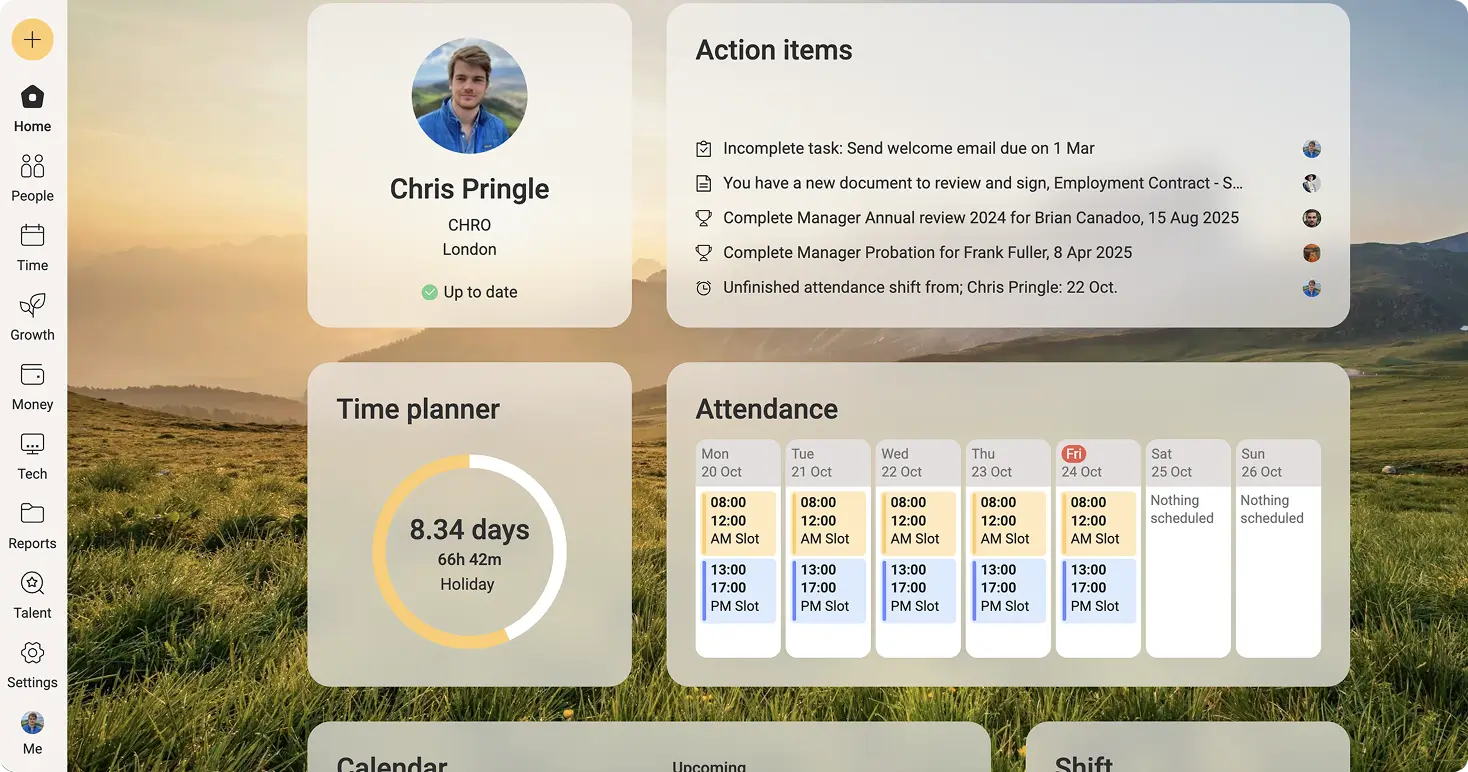
Zelt is a UK-built HR software that combines HR and payroll in one system. It gives growing UK businesses the joined-up people data Workday is known for, without the enterprise cost or long setup.
Who It’s Best For
Zelt suits UK small and mid-sized businesses with 50 to 1000 employees that want HR, payroll, benefits administration and performance in one place. It is a strong fit for teams that have outgrown spreadsheets or find enterprise suites too heavy.
Key Features
- Core HR records, documents and staff self-service
- UK payroll run in the same system as your HR data
- Onboarding and offboarding flows covering contracts, apps and devices
- Holiday, absence and time off management
- Performance reviews, goals and staff surveys
- IT device and software access management
Pros and Cons
| Pros | Cons |
|---|---|
| HR and UK payroll in one platform | Fewer enterprise-level talent tools than Workday |
| Built for UK SMBs from the start | Only support UK and GCC payroll |
| Modular, so you only pay for what you use | Not designed for very large global enterprises |
UK Pricing
Pricing starts from £5/employee/month. Zelt charges per employee each month, based on the modules you choose.
How It Compares to Workday
Zelt is simpler, faster to set up and built around UK payroll. Workday offers deeper succession planning and global workforce tools. If you are a UK business with up to a few hundred staff, Zelt will likely cover what you need at a fraction of the effort.
See how Zelt brings payroll, HR, and people management together in one connected platform.
Rippling: Best for Combining HR, IT and Payroll
Rippling is a US-founded platform that joins HR, IT and finance tools around one employee record. It is known for strong automation across many business apps.
Who It’s Best For
Rippling suits fast-growing businesses, often with teams in several countries, that want HR, payroll, devices and app access in one system.
Key Features
- Core HR and onboarding
- UK and global payroll
- Device and app management
- Workflow automation across connected apps
- Performance, learning and time tracking modules
Pros and Cons
| Pros | Cons |
|---|---|
| Powerful automation across HR and IT | Pricing can rise quickly as you add modules |
| Strong for global teams | Many settings may feel complex for small teams |
| Large app library | Built in the US, so check UK-specific features carefully |
UK Pricing
Pricing starts from £8/user/month. Rippling uses modular pricing with custom quotes.
How It Compares to Workday
Rippling is faster to set up and stronger on IT and device management. Workday offers deeper talent management and is better suited to very large organisations.
HiBob: Best for Mid-Sized Teams
HiBob’s platform, called Bob, is a modern HR system built for mid-sized, fast-growing companies. It is popular with tech and service businesses that care about culture and engagement.
Who It’s Best For
HiBob suits mid-sized companies, roughly from 50 to a few thousand staff, that want strong HR and talent features without enterprise complexity.
Key Features
- Onboarding flows and welcome tasks
- Performance cycles, goals and one-to-ones
- Compensation planning
- Engagement surveys and analytics
- Hiring and payroll options
| Pros | Cons |
|---|---|
| Modern design that staff enjoy using | Some features cost extra |
| Strong performance and compensation tools | Lighter succession tools than Workday |
| Good for hybrid and multi-office teams |
UK Pricing
Pricing starts from £8/employee/month. HiBob offers custom quotes based on headcount and modules.
How It Compares to Workday
HiBob is much easier to use and usually faster to roll out. It covers most talent needs for mid-sized firms, but Workday remains stronger for complex global structures and advanced workforce planning.
MHR iTrent: Best for UK Public Sector and Complex Payroll
iTrent is an HR and payroll system from MHR, a UK company based in Nottingham. It is widely used by councils, NHS bodies, universities and other large UK employers.
Who It’s Best For
iTrent suits UK public sector bodies and large organisations with complex pay rules, such as many pay grades, unions or public sector pension schemes.
Key Features
- UK payroll built for complex pay structures
- Core HR and staff self-service
- Absence and time management
- Learning and performance management
- Workforce reporting and analytics
Pros and Cons
| Pros | Cons |
|---|---|
| Strong UK payroll and public sector experience | Interface may feel less modern than newer tools |
| Handles complex pay rules | Setup can take time for large projects |
| UK-based supplier and support | Too complex for small businesses |
UK Pricing
Pricing starts from £7/user/month. MHR prices iTrent by custom quote.
How It Compares to Workday
iTrent is more focused on UK payroll and public sector rules. Workday offers stronger global and talent features, but iTrent is often a better fit for UK-only organisations with complex pay.
BambooHR: Best for Ease of Use
BambooHR is a well-known US HR platform built for small and mid-sized businesses. Its biggest strength is how easy it is for everyone to use.
Who It’s Best For
BambooHR suits small and mid-sized businesses that want simple HR software and already have a UK payroll provider they plan to keep.
Key Features
- Employee records and self-service
- Onboarding checklists and e-signatures
- Time off tracking with custom policies
- Performance management and goals on higher plans
- Employee satisfaction surveys
- Hiring and applicant tracking
Pros and Cons
| Pros | Cons |
|---|---|
| Very easy to learn and use | Payroll is US only, so UK firms need separate payroll |
| Fast setup | Some features feel built for US businesses first |
| Large integration marketplace | Limited for complex or large organisations |
UK Pricing
Pricing starts from £8/employee/month. BambooHR offers tiered plans priced by custom quote.
How It Compares to Workday
BambooHR is far simpler and quicker to set up. It lacks Workday’s payroll, workforce planning and deep talent tools, so it suits smaller teams with simpler needs.
Breathe HR: Best Low-Cost UK HR Software
Breathe is a UK HR system designed for small businesses. It covers the HR basics at a price most small firms can afford.
Who It’s Best For
Breathe suits UK small businesses that want an affordable HR tool for staff records, holidays, sickness and simple performance reviews.
Key Features
- Employee records and document storage
- Holiday and absence tracking
- Sickness tracking with Bradford Factor scores
- Performance reviews and objectives
- Mobile app for staff
Pros and Cons
| Pros | Cons |
|---|---|
| Low cost for small teams | No built-in payroll |
| Built for UK businesses | Not suited to large or complex organisations |
| Easy to set up | Fewer talent features than larger platforms |
UK Pricing
Pricing starts from £4/user/month. Breathe uses monthly plans based on headcount, with a free trial.
How It Compares to Workday
Breathe is not a like-for-like replacement for Workday. It is a good choice if Workday was always too big for your business and you need simple, low-cost HR.
Personio: Best for UK and European Compliance
Personio is an all-in-one HR platform from Germany. It helps businesses manage HR across the UK and Europe, with tools that respect local rules.
Who It’s Best For
Personio suits growing businesses with roughly 10 to 2,000 staff, especially those with teams in the UK and other European countries.
Key Features
- Recruitment and applicant tracking
- Onboarding and offboarding workflows
- Absence and attendance management by country
- Performance reviews and development plans
- HR workflow automation and reports
| Pros | Cons |
|---|---|
| Strong for UK and European teams | UK payroll usually runs through an integration |
| Good automation for HR tasks | Lighter talent tools than Workday |
| Easy to use for managers |
UK Pricing
Pricing starts from £8/employee/month. Personio offers tiered plans with custom quotes.
How It Compares to Workday
Personio is faster to set up and easier to manage for SMEs. Workday is stronger for large global firms, but Personio covers European HR needs well for growing businesses.
Zellis: Best for Payroll-Led HR in the UK
Zellis is one of the UK’s biggest payroll and HR suppliers. It is a strong option if payroll is the most important part of your people system.
Who It’s Best For
Zellis suits mid-sized and large UK employers with complex payroll, as well as businesses that want to outsource payroll to a managed service.
Key Features
- UK payroll for large and complex workforces
- Core HR and staff self-service
- Absence and time management
- Managed payroll services
- Workforce reporting
| Pros | Cons |
|---|---|
| Deep UK payroll expertise | Talent tools are less advanced than Workday |
| Managed payroll service available | Setup can take time for large projects |
| Suits large, complex workforces |
UK Pricing
Pricing starts from ~£6/user/month. Zellis prices by custom quote based on headcount and services.
How It Compares to Workday
Zellis focuses on UK payroll, while Workday focuses on global HR and talent. If getting UK pay right for thousands of staff is your top priority, Zellis is often a better fit.
Factorial: Best All-in-One Value
Factorial is an all-in-one HR platform from Spain built for small and mid-sized businesses. It packs a wide range of HR tools into one affordable system.
Who It’s Best For
Factorial suits SMEs that want HR, time tracking, shift planning and performance in one tool at a fair price.
Key Features
- Employee records and documents
- Time off, time tracking and shift planning
- Performance reviews and goals
- Onboarding and recruitment
- Expense and spend tools
- Mobile app for staff
Pros and Cons
| Pros | Cons |
|---|---|
| Wide range of features for the price | UK payroll runs through an integration |
| Easy to use | Less UK-specific than UK-built tools |
| Free trial available | Some features sit on higher plans |
UK Pricing
Pricing starts from £5/employee/month. Factorial uses tiered plans charged per employee.
How It Compares to Workday
Factorial costs far less and is much quicker to set up. It does not match Workday’s scale or deep analytics, but it covers most day-to-day HR for smaller businesses.
Sage People: Best for Multi-Country Teams
Sage People is a cloud HR platform from Sage, a well-known UK software company. It is built on Salesforce and designed for businesses with staff in several countries.
Who It’s Best For
Sage People suits mid-sized and larger businesses with international teams, especially those already using Sage finance tools.
Key Features
- Core HR across multiple countries
- Performance reviews and objectives
- Recruitment and onboarding
- Workforce planning and people analytics
- Staff and manager self-service
| Pros | Cons |
|---|---|
| Strong multi-country HR | Setup can be complex |
| Trusted UK brand | Usually too much for small businesses |
| Powerful reporting |
UK Pricing
Pricing starts from £8/employee/month. Sage People is priced by custom quote.
How It Compares to Workday
Sage People is the closest like-for-like option on this list for mid-market global firms. It usually costs less than Workday and suits companies that do not need Workday’s full enterprise scale.
How Much Do Workday Alternatives Cost in the UK?
Most Workday alternatives charge per employee, per month. Your final cost depends on headcount, the modules you choose and how much setup help you need.
Many suppliers do not publish full prices, so you will often need a quote. Here are the main pricing models you will see:
| Pricing model | How it works | Common with |
|---|---|---|
| Per employee, per month | A set fee for each person on the system | Zelt, Factorial |
| Modular pricing | You pay for each module, such as HR, payroll or IT | Zelt, Rippling, HiBob |
| Tiered plans | Basic, middle and top plans with more features at each level | BambooHR, Personio, Breathe |
| Enterprise contract | A custom yearly or multi-year contract | MHR iTrent, Zellis, Sage People |
Here is a simple illustration. If a platform charged £10 per employee each month for HR and payroll, a 150-person business would pay £1,500 a month or £18,000 a year. This is an example only, not a real price.
Also ask about setup fees, data migration, training, payroll parallel runs and support costs. With Workday, these extra costs can be large. With many alternatives, they are much smaller, but you should still check.
Key Features to Look For in a Workday Alternative
You do not need every Workday feature. Focus on the ones your teams use every week.
| Feature | What to check | Why it matters |
|---|---|---|
| Core HR | Staff records, documents and self-service | Your single source of people data |
| UK payroll | Built in or linked to your provider, with RTI submissions to HMRC | Avoids double data entry and pay errors |
| Onboarding and offboarding | Contracts, right to work checks and IT access | Gives new starters a smooth first day |
| Time off and absence | UK holiday rules, sickness and family leave | Keeps balances and pay accurate |
| Performance and talent | Reviews, goals, feedback and development | Replaces Workday’s talent tools |
| Reporting | Headcount, turnover, absence and cost reports | Helps leaders make decisions |
| Integrations | Links to finance, Slack, Microsoft Teams and recruitment tools | Keeps data flowing between systems |
| Data protection | UK GDPR support and clear data hosting | Protects sensitive staff data |
If you used Workday’s succession planning or skills tools heavily, test these areas carefully. Some alternatives cover them well, while others only offer the basics.
How to Choose the Right Workday Alternative
The right choice depends on your size, your payroll needs and how your teams work. These steps will help you compare options fairly.
Match the Platform to Your Company Size
Start with your headcount today and in three years. A 60-person firm and a 3,000-person NHS trust need very different tools.
As a rough guide, startups and small firms often suit CharlieHR, Breathe or Zelt. Mid-sized businesses often look at Zelt, HiBob, Personio or Rippling. Large or complex UK employers may prefer MHR iTrent, Zellis or Sage People.
Decide How You’ll Run UK Payroll
Payroll is often the hardest part of leaving Workday. Decide early whether you want payroll inside your HR system, a separate payroll tool or a managed payroll service.
Built-in payroll means less data entry and fewer mistakes. A separate provider can work well too, as long as the two systems sync reliably.
Compare Total Cost, Not Just Licence Fees
The monthly price is only part of the cost. Add up setup, data migration, training, support and any extra modules over three years.
This gives you a fair comparison with your current Workday spend, including any consultancy fees you pay to make changes.
Check UK GDPR and Data Hosting
HR systems hold sensitive data such as pay, health and performance notes. You must protect it under UK GDPR.
Ask each supplier where your data is stored and whether it leaves the UK. If it does, check the right safeguards are in place. The ICO’s guidance on international transfers explains what to look for.
Ask for a Demo Using Your Own Processes
Do not settle for a standard sales demo. Send each supplier two or three real processes from your business.
For example, ask them to onboard a new starter, process a pay rise and run a year-end review. This shows how each tool handles your actual work, not just its best features.
>See also:
10 Best ADP Alternatives for UK Businesses
How to Switch From Workday
Moving away from Workday takes planning, but it does not have to be painful. Most of the work comes down to timing, data and people.
Check Your Contract and Renewal Date
Workday contracts often run for several years. Check your end date, notice period and any data export terms before you start talking to new suppliers.
Give yourself enough time. Many businesses start their search six to twelve months before renewal so they can test options without rushing.
Plan Your Data Move
List the data you need to move, such as staff records, job history, holiday balances, documents and performance notes. Then decide what you can leave behind.
Clean your data before you move it. Removing old records and fixing errors now saves time and makes the new system more useful from day one.
Time Your Payroll Switch With the Tax Year
The UK tax year starts on 6 April. Switching payroll at the start of a new tax year is often simplest, because you do not need to move year-to-date pay and tax figures.
You can switch mid-year, but you will need to carry over each employee’s year-to-date figures carefully. Many businesses also run both payrolls side by side for a month or two to check the results match.
Train Managers and Staff
A new system only works if people use it. Give managers short, practical training on the tasks they do most, such as approving leave and running reviews.
For staff, a quick guide or short video on booking time off and updating details is usually enough. Ask your new supplier what training and support they include.
Why Zelt Is the Best Workday Alternative
Workday is built for large global enterprises. For most UK small and mid-sized businesses, Zelt is the best Workday alternative. It gives you one joined-up system for your people without the enterprise price tag or months of setup. Here is why UK teams choose Zelt:
- HR, payroll and IT in one place. A new starter’s contract, payroll details and laptop can all be set up in one flow. When someone leaves, their pay and app access are handled together.
- Built for the UK. UK payroll, UK holiday rules and UK ways of working are part of the core product, not an add-on.
- Faster to go live. Zelt is designed to be set up without a long consultancy project.
- Pay only for what you need. Modular pricing means you can start with HR and payroll, then add more as you grow.
- Easy for everyone. Staff can book leave and update details themselves, and managers can approve requests in a few clicks.
To be fair, Workday may still suit a very large global enterprise with complex workforce planning needs. But if you are a UK business that wants the core of what Workday does, with less cost and complexity, Zelt is a smart place to start.