Staff Turnover Calculator: Calculate Employee Turnover Rate
If you are an employer or part of an HR team, staff leaving too often can be stressful and costly. High turnover can slow projects, hurt team morale and increase hiring expenses.
Our staff turnover calculator helps you solve this problem. Use the calculator below to quickly how many employees leave and also estimates the cost to replace them. It helps you to make smarter HR decisions and keep your team stable with this information.
| Setting | Value | Unit |
|---|---|---|
| Employees at Beginning | – | |
| Employees at End | – | |
| Number of Employees Who Left | – | |
| Average Annual Salary | £ per year | |
| Estimated Replacement Cost | % of salary | |
| Turnover Rate | 0% | % |
| Estimated Annual Turnover Cost | £0 | £ per year |
| Note: Simplified estimate; replacement cost percentage may vary by role and seniority. | ||
Download Staff Turnover Calculator for Excel

To see how these values are calculated and understand the true cost of employee turnover in your organisation, download the Excel staff turnover calculator by entering your details below to receive it via email
How to Use Our Staff Turnover Calculator
Using our employee turnover calculator is quick and easy. Simply enter:
- Employees at the beginning and end of the period
- Number of employees who left
- Average annual salary
- Estimated replacement cost (%)
Then click Calculate. Instantly, you’ll see your turnover rate (%) and estimated annual turnover cost (£). This helps you understand both the movement of your staff and the financial impact, so you can make smarter HR decisions.
What is Staff Turnover?
Staff turnover, also known as employee turnover, is the rate at which employees leave a company over a particular period of time. It is measured as a percentage (%). It helps employers to understand how stable their team is.
Turnover is normal in every business. But a high employee turnover rate can slow down a company’s growth and if your staff is leaving in large groups then it will affect your company culture. The average labour turnover rate in the UK is approximately 34% according to the recent analysis from the (CIPD), . Understanding your employee turnover rate helps you to know which areas of your business need improvement. Also, it can help you to identify the root cause of why your people are leaving.
What is an employee Turnover Calculator?
An employee turnover calculator is a simple tool that helps you measure how many employees leave your company over a period of time. It also shows the financial impact of those departures by estimating replacement costs. In short, it turns HR data into easy-to-understand numbers so you can track workforce stability and make better decisions.
Types of Staff Turnover
There are two main types of staff turnover. Let me explain them in detail:
1. Voluntary Turnover
This happens when an employee chooses to leave the company. Common reasons include:
- Better job opportunity
- Higher salary elsewhere
- Work-life balance issues
- Career growth concerns
- Personal reasons
For example, if an employee resigns to join another company, that is voluntary turnover. High voluntary turnover can be a warning sign. It may mean employees are not fully satisfied or engaged and the issue is salary, team dynamics or management.
2. Involuntary Turnover
This happens when the company decides to end the employment. Common reasons include:
- Poor performance
- Misconduct
- Company restructuring
- Redundancy or layoffs
In this case, the decision is made by the employer. Both types matter. But voluntary turnover often gives stronger signals about employee satisfaction and workplace culture.
Understanding voluntary vs involuntary turnover is crucial. For a broader look at attrition types and how to improve employee experience, see our article on employee attrition and retention
Why Monitoring Turnover Helps Your Business
Now you may ask, why should we track staff turnover closely? Here’s why it matters:
- It controls costs: Monitoring turnover helps you reduce unnecessary costs because hiring and training new employees is expensive. When someone leaves, you lose time and money.
- It protects productivity: High turnover can reduce overall performance when projects slow down and teams need time to adjust.
- It improves employee retention: You can spot patterns early by calculating staff turnover regularly. For example, are many employees leaving one department? That tells you where to focus.
- It supports better decision-making: Turnover data helps HR leaders and managers make smarter workforce plans. Instead of guessing, you use real numbers.
That’s exactly why many HR teams use a turnover rate calculator. It turns simple employee data into useful insights. And once you see the numbers clearly, you can take action with confidence.
How to Calculate Staff Turnover Yourself
Our employee turnover calculator makes the process quicker and easier. But if you want to calculate it yourself then the formula you need is:
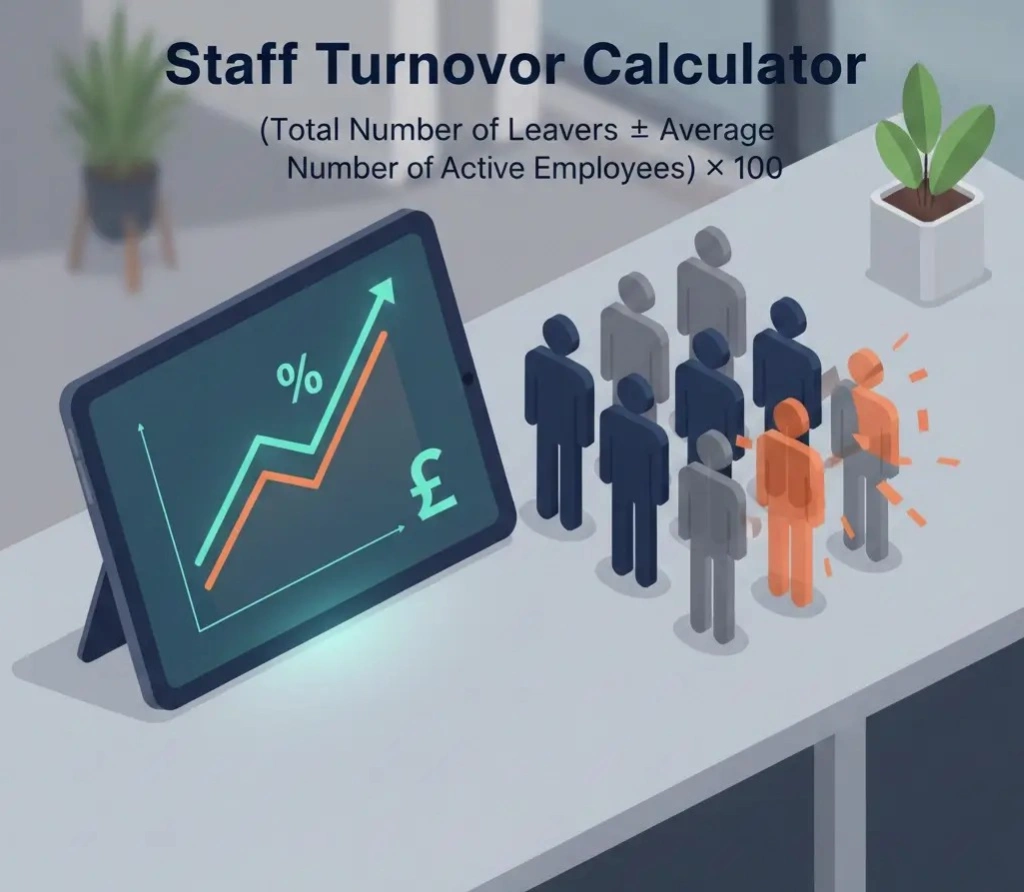
(Total Number of Leavers ÷ Average Number of Active Employees) × 100
Both figures must cover the same time period. For example, if 11 employees left during the year and you had an average of 200 active employees:
11 ÷ 200 = 0.055
0.055 × 100 = 5.5% turnover rate
The calculation itself is simple. The only part that may take extra effort is working out your average number of active employees. You can do that by choosing a set time period (for example, a month or a year). Take the number of employees at the start of that period and the number at the end. Then calculate the average:
(Employees at Start + Employees at End) ÷ 2
This gives you the average number of active employees for that period. You then divide the number of leavers by the average number of employees and multiply by 100 to calculate your staff turnover rate for the selected period.
Reduce Staff Turnover and Improve Retention
Reducing staff turnover is not about stopping people from leaving completely. That is not realistic. Instead, the goal is to keep your best employees engaged, motivated and committed to your organisation.
Let me share something important with you: most employees do not leave suddenly. In many cases, the warning signs appear months earlier, low engagement, poor feedback, lack of growth or weak leadership. That’s why improving retention must be proactive, not reactive.
Strategies to Increase Employee Retention
Here are practical, proven strategies HR professionals use to increase retention:
- Offer Clear Career Growth
- Improve Communication and Feedback
- Ensure Competitive Pay and Benefits
- Strengthen Workplace Culture
- Support Employee Wellbeing
Retention is not one big solution. It is a combination of many small, consistent improvements.
Flexible Working and Staff Turnover
Flexible working has become one of the strongest tools for reducing turnover. Why? Because many employees value flexibility as much as salary. Remote work or flexible hours can increase satisfaction. Organisations that offer flexible working arrangements often report:
- Higher engagement
- Lower absenteeism
- Reduced voluntary turnover
That’s what it means in practical terms:” flexibility builds loyalty “. However, flexible working must be managed properly.
Using Performance Management Software to Retain Talent
Structured performance processes help employees grow. That’s why modern HR teams choose a performance management system to improve retention. A strong performance management approach includes:
- approach includes:
- Regular goal setting
- Ongoing feedback
- Structured performance reviews
- Recognition and development planning
When employees understand their goals and receive consistent support, they feel valued and are less likely to leave.
Conclusion
Staff turnover affects both your team and your business costs. By using our staff turnover calculator, you can quickly see how many employees leave and the cost to replace them. You can retain your best employees and keep your team stable by tracking turnover and taking action with strategies like flexible working, career growth and performance management.
Frequently Asked Questions
What is a Good Turnover Rate in the UK?
A good turnover rate depends on your industry, company size and location. In many UK industries, an annual staff turnover rate between 10% and 20% is considered normal. That’s what it usually looks like in stable organisations. However, there is no single “perfect” number.
Industries like retail and hospitality often have higher turnover. While professional services and finance usually have lower turnover.
Is a 15% Turnover Rate Considered High?
A 15% turnover rate is not automatically high. In many industries, it falls within a normal range. But context matters. You have to ask yourself:
- Is it higher than last year?
- Are top performers leaving?
- Is turnover concentrated in one department?
You may require an investigation only if your turnover has increased from 8% to 15% in one year. It may not be a concern if it has stayed stable around 15% for several years and your industry average is similar.