Salary Sacrifice Calculator UK 2026
Many UK employees and employers find salary sacrifice confusing. It’s not always clear how much pay you give up or how tax, National Insurance, and pensions affect your take-home pay. Without clear numbers, people can miss out on savings or make choices without knowing the real impact on their salary.
| Setting | Value | Unit |
|---|---|---|
|
Gross annual salary
Employee pension
Employer pension
Employer NI savings given up
|
|
£ per year
%
|
| Gross salary after sacrifice | — | per year |
|
Total pension contribution
Take-home pay after sacrifice
|
—
—
|
per year
per year
|
|
Employee PAYE savings
Employee NIC savings
Employer NIC savings
|
—
—
—
|
per year
per year
per year
|
| Note: Based on 2026/2027 tax rates, 1257L tax code and NI letter A. | ||
This UK Salary Sacrifice Calculator helps solve that problem. It shows how salary sacrifice affects gross pay, tax, National Insurance and pension contributions in one simple view. You can quickly see potential savings by using our salary exchange calculator and understand whether salary sacrifice is the right option for you in 2026 or not.
Download the Salary Sacrifice Calculator for Excel

To understand the full impact of salary sacrifice on pay, tax, and pension contributions, download the Excel salary sacrifice calculator by entering your details to receive it via email.
What Is Salary Sacrifice?
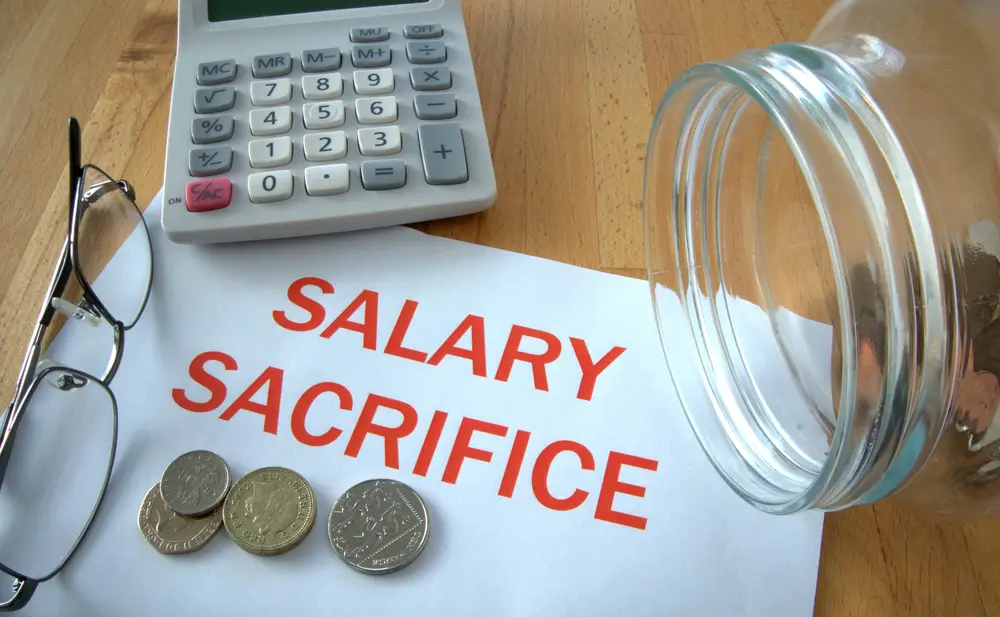
Salary sacrifice or salary exchange is a way where an employee gives up a part of their pay and in return, receives a benefit from their employer. It is a contractual agreement between both of them and is often used to save money on tax and National Insurance (NI). Instead of taking cash, an employee agrees to receive something else that has value, like extra pension contributions or a company car.
Salary sacrifice can include two types of benefits:
- Cash benefits: Sometimes you receive a part of your pay in a different form like extra pension contributions, which you can access when you retire.
- Non-cash benefits: These benefits include a bike to work, childcare vouchers or even a company car. In simple words, you receive a benefit instead of cash.
In short, it’s a smart way for both the employee and the employer to save money in the UK by changing a part of their pay into useful benefits.
How Salary Sacrifice Works in the UK
Salary sacrifice in the UK is simple once you know the steps. Let me share the steps:
- Employee Agreement: First, the employee and employer agree on the salary exchange. This agreement is written in your contract. It clearly states how much of your salary you will give up and what benefits you will receive in return.
- Salary Reduction: After agreement, your gross salary is reduced by the amount you agreed to sacrifice. This means your take-home pay will be lower but only the part that is exchanged for benefits.
- Employer Provides the Benefit: Your employer uses the sacrificed salary to provide the benefit you chose. For example, they may add more to your pension or any other benefit.
- Tax & NI Calculation: Finally, you pay less Income Tax and National Insurance (NI) because your gross salary is now lower. This is one of the main reasons salary exchange is popular in the UK. Both you and your employer can save money this way.
Salary Sacrifice vs Normal Deductions
Salary sacrifice is different from normal deductions like standard pension contributions. Your salary is taxed first and then normal deductions are made. This means you pay tax on the full salary before the benefit is applied. Meanwhile, in salary exchange, your salary is reduced before tax and NI is calculated. This reduces the amount of tax and NI you pay.
Types of Salary Sacrifice Schemes in the UK
There are many salary sacrifice schemes in the UK, but let me quickly share some common ones.
SMART Pension Salary Sacrifice
In a SMART Pension Salary Sacrifice scheme you, as an employer, give up a part of your pay and it goes into your pension. It lowers the tax and National Insurance you pay. That means you save money while building your retirement fund.
Electric Car Salary Sacrifice
With the Electric Car Salary Sacrifice, you can lease an electric car using part of your salary. Electric cars save your money due to lower tax as a Benefit-in-Kind. It is a popular scheme in the UK for people who want a green and cheaper way to travel.
Cycle to Work Scheme
The Cycle to Work Scheme lets you get a bike for commuting without paying tax on it. There are limits on how much the bike can cost. Cycling is healthy and can also save you money on travel.
Childcare Salary Sacrifice (Closed Scheme)
Some old schemes let employees use pay sacrifice for childcare. These are closed to new employees, but people who joined earlier can continue. They still get tax and NI savings on their contributions.
Holiday Purchase Scheme
The Holiday Purchase Scheme allows you to buy extra holidays by giving up part of your salary. The cost is taken from your pay before tax, so you can get more time off in a tax-smart way.
Travel, Tech & Other Benefits
Salary exchange can also be used for other things like travel passes or mobile phones. These benefits come from your salary before tax. It helps you save money while getting useful items for work or commuting.
Salary Sacrifice Tax Savings Explained
Salary sacrifice can help both employees and employers save money on taxes. Let’s see how it works.
Income Tax Savings
When you give up part of your salary for benefits, your gross salary becomes lower. Since Income Tax is calculated on your gross salary, you pay less tax. This means more of your money goes into your benefits, like pensions, instead of being taxed.
Employee National Insurance (NI) Savings
National Insurance is also calculated on your salary. By reducing your salary through pay sacrifice, you pay less NI. You can take help from our our employer NI calculator to see your exact savings. This is another way you save money while still getting the benefit.
Employer National Insurance (NI) Savings
Employers also pay NI on your salary. When your salary is reduced, the employer pays less NI. Some employers even share part of their savings by adding more to your pension contributions or benefits.
| Item | Before Salary Sacrifice | After Salary Sacrifice | Savings |
| Gross Salary | £38,000 | £35,000 | £3,000 |
| Income Tax | £5,486 | £5,086 | £400 |
| Employee NI | £3,780 | £3,450 | £330 |
| Employer NI | £5,244 | £4,830 | £414 |
| Pension Contribution | £1,900 | £4,900 | +£3,000 |
Explanation:
- The table shows a simple example for a UK employee.
- Giving up £3,000 salary increases pension contributions and reduces both tax and NI.
- The total savings include employee tax, employee NI, and employer NI benefits.
Salary Sacrifice Examples (Real Scenarios)
Salary sacrifice can save money and provide benefits in many ways. Here are some real-life examples of how it works in practice, including pensions, electric cars, and cycle-to-work schemes.
Example 1 – Pension (SMART)
Scenario:
- Employee earns £40,000/year
- Contributes 5% of salary via salary sacrifice into pension
- Employer contributes 5% as well
Explanation:
- Gross salary is reduced by the pension contribution
- Employee pays less tax and National Insurance
- Total pension pot grows faster due to tax relief and employer contribution
SMART Calculation:
| Item | Amount (£) |
| Original Gross Salary | 40,000 |
| Employee Contribution | 2,000 |
| Employer Contribution | 2,000 |
| New Gross Salary | 38,000 |
| Tax Saved | 400 |
| NI Saved | 240 |
| Take-Home Pay | 29,760 |
| Total Pension Contribution | 4,000 |
Tip: Using a salary sacrifice pension plan is one of the most effective ways to save tax while boosting retirement funds.
Example 2 – Electric Car
Scenario:
- Employee opts for a company electric car via salary sacrifice
- Car’s monthly value: £400
- Employee saves income tax and NI on the sacrificed amount
Explanation:
- Instead of taking cash salary, £400/month is deducted for car use
- Reduces taxable salary, lowering tax and NI contributions
- Employer may also save on National Insurance contributions
| Item | Amount (£) |
| Original Gross Salary | 40,000 |
| Salary Sacrifice – Car | 4,800/year |
| New Gross Salary | 35,200 |
| Tax Saved | 960 |
| NI Saved | 576 |
| Take-Home Pay | 27,664 |
Tip: Electric cars benefit from low Benefit-in-Kind (BIK) tax rates in 2026, making this a smart eco-friendly option.
Example 3 – Cycle to Work
Scenario:
- Employee buys a bike via cycle-to-work salary sacrifice scheme
- Cost of bike: £1,200, repaid over 12 months
Explanation:
- The £100/month salary sacrifice reduces gross pay
- Employee saves income tax and NI on the sacrificed amount
- Encourages sustainable commuting and healthier lifestyle
| Item | Amount (£) |
| Original Gross Salary | 40,000 |
| Salary Sacrifice – Bike | 1,200/year |
| New Gross Salary | 38,800 |
| Tax Saved | 240 |
| NI Saved | 144 |
| Take-Home Pay | 30,416 |
Tip: Cycle-to-work schemes are a small sacrifice for big lifestyle and tax benefits.
Pros and Cons of Salary Sacrifice
Benefits for Employees
Salary sacrifice helps employees save money on tax and National Insurance. You can increase your pension, get a bike, or lease an electric car at lower cost. It’s a smart way to get extra benefits without losing much pay. Employers can also reduce National Insurance contributions using salary sacrifice, learn how to Save National Insurance with Salary Sacrifice pension
Benefits for Employers
Employers also save on National Insurance when employees use pay sacrifice. They can offer attractive benefits to staff, boost morale, and encourage long-term savings or healthier habits.
Potential Drawbacks to Consider
Salary sacrifice may reduce your take-home pay, which can affect loans or mortgages. Some benefits are fixed, so you can’t get the cash back. It’s important to check your contract and make sure the scheme suits your needs.
You can also use a modern payroll system like Zelt to automate the NI savings calculations, making it easier for employers to implement salary sacrifice schemes without administrative errors.
Salary Sacrifice and UK Legal Rules
Salary sacrifice schemes are legally allowed in the UK, but they must comply with specific rules to protect both employers and employees. Understanding these rules ensures your pay sacrifice is valid, fair, and does not reduce statutory entitlements below legal limits.
National Minimum Wage rules
Key points:
- pay sacrifice cannot reduce an employee’s cash pay below the National Minimum Wage (NMW) or National Living Wage (NLW).
- Employers must check the reduced salary after the sacrifice is above the minimum required by law.
- Example: If the NMW for a 25-year-old employee is £11.44/hour (2026), their reduced hourly pay after salary exchange must still meet this rate.
Contractual agreement requirement
Key points:
- pay sacrifice must be agreed in writing and form part of the employee’s contract.
- Employees cannot be forced into a salary exchange scheme.
- Any changes to salary or benefits must be mutually agreed and documented.
Impact on statutory benefits
Sacrificed salary can affect statutory payments because some are calculated on gross salary.
Maternity Pay
- Statutory Maternity Pay (SMP) is based on average weekly earnings.
- Salary sacrifice that reduces gross pay can reduce SMP.
- Employers should carefully calculate to ensure employees still meet eligibility thresholds.
Sick Pay
- Statutory Sick Pay (SSP) is calculated from gross pay.
- Pay sacrifice could lower SSP if gross pay falls below the minimum qualifying level (£123/week in 2026).
Redundancy Pay
- Redundancy pay is based on weekly gross salary.
- Salary exchange reduces gross pay, which could reduce redundancy entitlement.
- Some employers provide adjusted calculations to avoid lowering statutory benefits while still offering salary exchange advantages.
Conclusion
Salary sacrifice is a legal and smart way for UK employers and employees to reduce tax and National Insurance while gaining benefits like higher pension contributions or cycle-to-work schemes. With our salary sacrifice calculator, you can quickly see how a small reduction in gross pay can lead to long-term savings.
Frequently Asked Questions
What is the salary sacrifice?
Salary sacrifice, also called salary exchange, is a legal agreement where an employee gives up part of their pay in return for benefits from their employer. It can include a car, increased pension contributions or workplace perks.
How much will I save on salary sacrifice?
How much you will save depends on your gross salary, pension contributions and chosen benefits. You can use our salary sacrifice calculator to see exactly how much tax and National Insurance you’ll save along with your new take-home pay.
Is it worth doing a salary exchange?
If you want to reduce tax and NI, or access perks like electric cars or cycle-to-work schemes, then it will definitely be worth it.
Does salary sacrifice reduce salary?
Yes. It reduces your gross pay by the amount you exchange for benefits. This lower salary is used to calculate tax but you gain valuable benefits in return.
How much of my salary can I safely sacrifice?
You can only give up part of your salary that keeps your pay above the minimum wage. You should also think about how it might affect things like maternity pay, sick pay, or loans before deciding.
Are salary sacrifices good?
Yes, if used carefully. Pay sacrifice can help you save tax, pay less National Insurance, and grow your pension. It works well for people in higher tax brackets or anyone wanting to make the most of their pay.
Can pay sacrifice reduce higher-rate tax?
Yes. By lowering your gross salary, you may pay less 40% or 45% tax. This can save you money if you earn enough to be in the higher tax brackets.